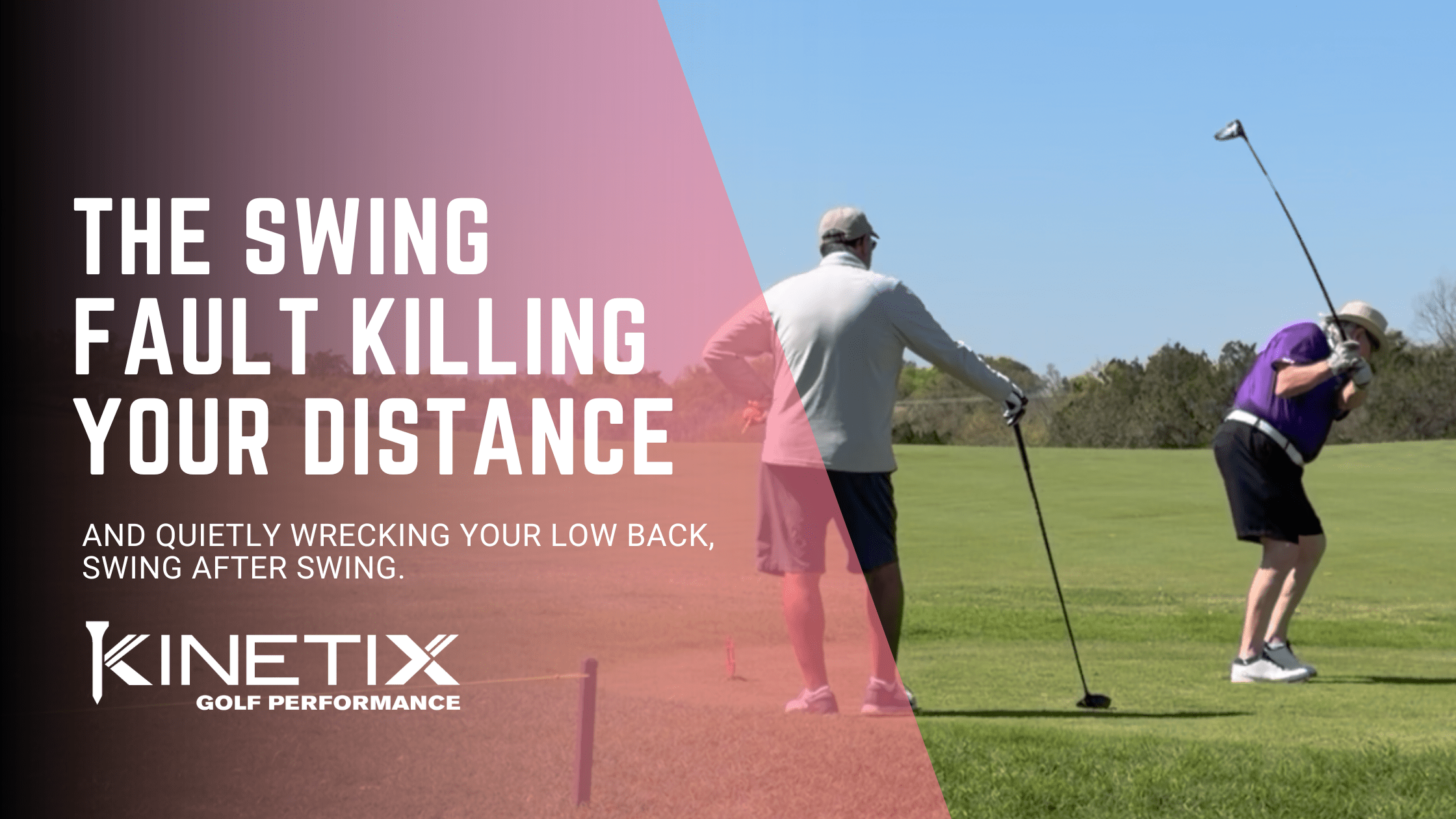
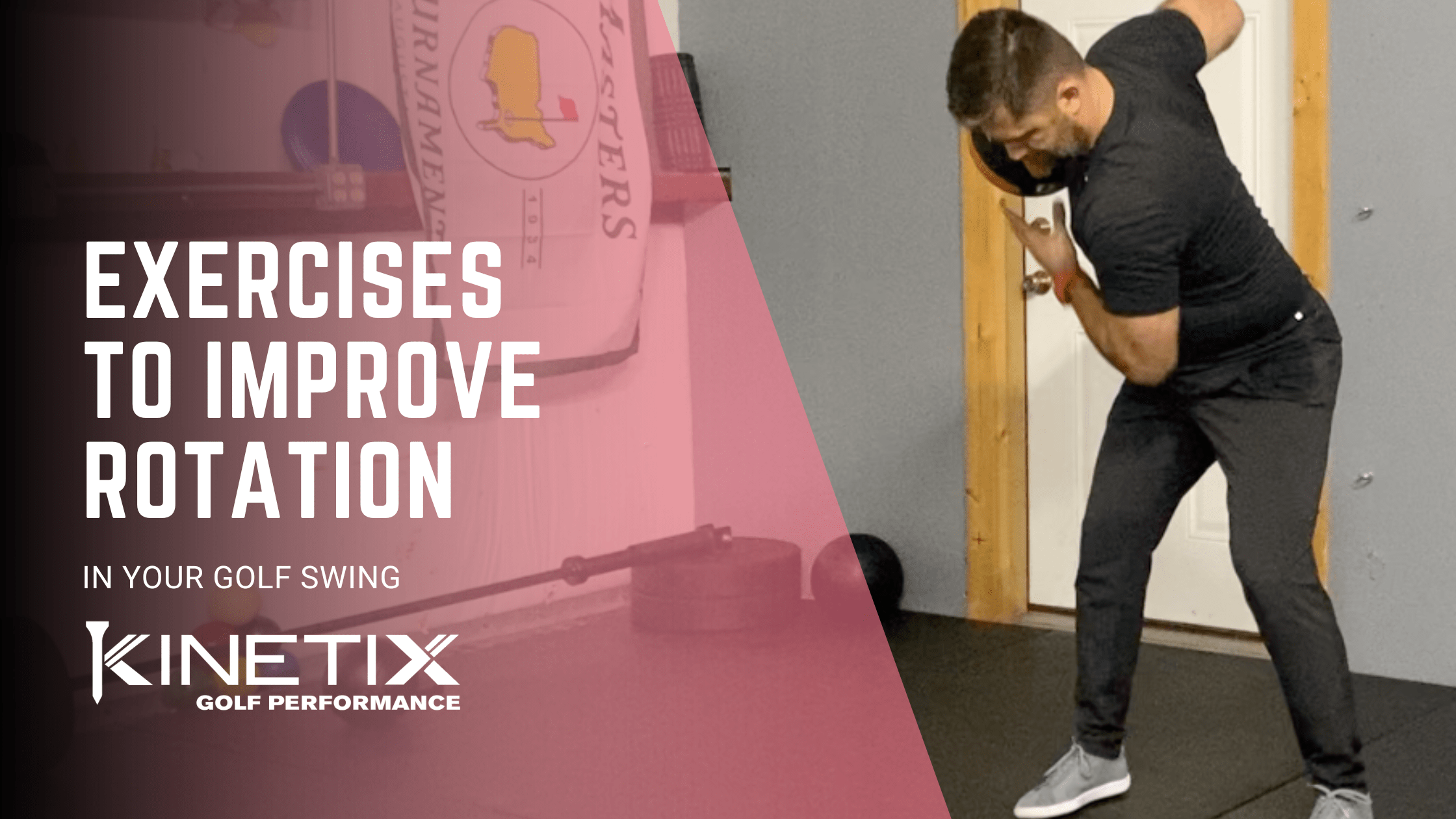
If your numbers drop and your back starts talking to you by hole 14, you don’t have two problems. You have one: early extension.
⚠️ The key insight
Early extension isn’t two separate problems. The same compensation pattern that’s capping your clubhead speed is also the mechanism quietly overloading your low back, swing after swing.
What Early Extension Actually Costs You
Early extension is when your hips and spine move toward the ball through impact instead of holding your posture and rotating around a stable spine angle. You “stand up” out of the swing early — and it’s one of the most common faults we see on the TPI screen.
On the performance side, this kills you in two ways:
Less ground force transfer — you lose the stable base needed to push speed into the club
Inconsistent compression — your low point and face angle become unpredictable, leading to thin shots, toe strikes, and lost yardage
What It’s Doing to Your Back
To still get the club to the ball after standing up early, your spine compensates with repeated lateral flexion (side-bending) through impact. For a right-handed golfer, that means the left side of the low back absorbs that load over and over — which is why pain tends to show up specifically on the left side, and specifically as the round (or fatigue) builds.
Two Costs, One Cause
performance cost
Lost Distance & Consistency
📉 Backswing through Impact
Standing up early disconnects your lower body from the ground right when you need it most — costing ground force transfer, compression consistency, and clubhead speed.
physical cost
Low Back Loading
⚠️ Impact, Round After Round
The same compensation forces the lumbar spine into repeated lateral flexion — loading the left-side paraspinals for a right-handed golfer, swing after swing, hole after hole.
Why “Swing Thoughts” Don’t Fix It
Early extension is rarely a conscious habit — it’s usually a compensation for something your body can’t physically do yet. The most common drivers we see:
Driver 1
Restricted Hip Internal Rotation
Especially the trail hip. When it can’t internally rotate through the downswing, the body finds power by standing up instead — trading posture for the rotation the hip should have provided.
Driver 2
Poor Pelvis-to-Thorax Sequencing
When the hips and ribcage don’t separate and fire in the correct order on the downswing, the body compensates by extending early to find a way to deliver the club.
Driver 3
Core & Glute Stability Breakdown
Holding a hinged, rotated posture under load takes real endurance. When core and glute stability fatigue over 18 holes, posture is usually the first thing to go.
Telling yourself to “stay down” works for about five swings. Building the physical capacity to actually hold posture is what fixes it for good — that’s the difference between a swing thought and a swing fix.
How We Build the Fix: Hip Strength, Mobility, and Posture
Since early extension is a physical limitation rather than a habit, the fix has to be physical too. Kinetix programming targets the three specific capacities that let you hold your spine angle through impact instead of compensating for it.
Hip Internal Rotation
Restores the range your trail hip needs to rotate through the downswing without your spine bailing it out by extending early.
Hip 90/90 Work
Builds active internal and external rotation range at the hip — the exact range early extension is hiding from.
Adductor Rockbacks
Frees up inner hip restriction that limits how deep the trail hip can load in the backswing.
Glute & Core Stability
Builds the posterior chain and core endurance to hold a hinged position under load — not just at swing one, but at swing ninety.
Hip Hinge Patterning
Trains your body to load the hips and hamstrings instead of the low back — the foundation of holding posture through impact.
Anti-Extension Core Work
Builds the core endurance to resist the spinal extension that creeps in as you fatigue late in a round.
Pelvis-to-Thorax Sequencing
Trains the separation between hips and ribcage so power moves up through the body in order — instead of your spine compensating for a sequencing gap with early extension.
🏥 The clinical lens
We use a TPI-based assessment to pinpoint exactly where your swing is breaking down — restricted hip mobility, a sequencing gap, or stability that fatigues under load — and build a training plan to close that specific gap, rather than guessing with generic mobility work.
Find Out If Early Extension Is Capping Your Swing
Take the free 2-minute Swing Limiter Quiz and get a personalized result based on your specific limitations.
Educational Disclaimer: This content is for informational and educational purposes only and does not constitute medical advice, diagnosis, or treatment. If you are experiencing significant or persistent low back pain, please consult a qualified healthcare provider before beginning any exercise program. Golf performance services provided through Kinetix Golf Performance are fitness and coaching in nature, separate from clinical chiropractic services at Kinetix Sport + Spine.
Already dealing with the back pain side of this? Our partner clinic, Kinetix Sport + Spine, specializes in golf-specific low back pain assessment and treatment.
Golf looks like a gentle sport on the knees. No running. No jumping. No contact. Yet the knee is consistently among the top three injury sites in golf — and the pain often surprises golfers when they first feel it, because the knee’s vulnerability isn’t obvious until you understand what’s happening above and below it.
The reason is simple: the knee is a stable joint surrounded by two of the most mobile joints in the body. When the ankle below it or the hip above it fails to move the way the golf swing demands, the knee absorbs the consequence — asked to rotate, translate laterally, and accept torsional forces it was never designed to handle.
⚠️ The key insight
Most golf knee pain is not a knee problem. It is an adjacent joint failure problem — the hip above or the ankle below not doing their jobs, forcing the knee to compensate. This is the same regional interdependence pattern that drives low back pain in golfers, expressed at a different joint.
The Knee’s Role: A Stable Joint in a Rotational Sport
The knee is a modified hinge joint. Its primary movements are flexion and extension. It has modest capacity for internal and external rotation when flexed, managed by the cruciate ligaments, collateral ligaments, and menisci. It is not designed to be a primary rotator or to absorb significant torsional load.
The golf swing catches the knee between two mobile joints doing their jobs, transmitting the forces generated between them. When those adjacent joints do their jobs correctly, the knee manages this well. When they don’t, the knee is forced to participate in a way it was never intended to.
Two Knees, Two Completely Different Problems
trail knee
right knee (RH Golfer)
⬆️ Backswing — Stability Demand
Must maintain its flex angle and resist the rotational torque being generated above it. Acts as the stable post the backswing coil anchors against. When it fails, it typically collapses inward (valgus) or extends prematurely.
lead knee
Left Knee (RH Golfer)
⬇️ Impact & Follow-Through — Load Demand
Bears significant body weight while the entire body rotates around it at maximum speed. Must absorb the deceleration forces of the swing — compressive and torsional load simultaneously at the highest-force moment.
What Loads the Trail Knee
Trail knee
Restricted Hip External Rotation
When the trail hip lacks external rotation range, the pelvis cannot rotate fully in the backswing without the trail knee rotating inward to compensate. The medial structures — the MCL, medial meniscus, and pes anserine tendons — take the load the hip was supposed to absorb.
Trail knee
WEak hip abductors and external rotators
The glute medius and deep hip external rotators are the primary stabilizers of the trail knee against valgus collapse. When weak or poorly recruited, the knee has no muscular defense against the rotational and valgus forces of the backswing.
Trail knee
Foot and Ankle Mechanics
Excessive supination from an already restricted ankle reduces the shock absorption capacity of the foot and ankle system and transfers more force directly to the knee above. Small changes in foot mechanics produce outsized effects at the knee over the course of a round.
Common trail knee complaints: Medial knee pain, IT band tension at the lateral knee, pes anserine bursitis, and diffuse aching from sustained rotational load on structures not conditioned to manage it.
What Loads the Lead Knee
Lead knee
Insufficient hip internal rotation
The lead hip must internally rotate through the downswing and into impact to allow the pelvis to clear. When restricted, the pelvis stalls — and the lead knee rotates inward to compensate. This is one of the most common mechanisms of lead knee medial stress in golfers and is directly related to hip mobility.
lead knee
early extension
Standing up out of the hip-hinged golf posture during the downswing dumps excessive vertical compressive force through the lead knee at a moment when it is already under rotational stress. The combined loading of compression and torsion is particularly aggressive on the lead knee’s cartilage and ligamentous structures.
lead knee
poor single-leg eccentric control
Golfers who lack single-leg stability — particularly the ability to control the lead leg’s deceleration through the follow-through — place the lead knee’s stabilizing structures under chronic eccentric demand without adequate muscular support. The posterior chain must decelerate the follow-through; when it cannot, the knee does.
Common lead knee complaints: Medial knee pain from valgus stress, patellofemoral discomfort from compressive load, IT band tension from rotational friction, and cartilage-related pain that worsens progressively through a round as fatigue reduces muscular protection.
🔗 The pattern both knees share
Despite their different stress profiles, both knees share the same vulnerability: they are stable joints between mobile joints that are frequently restricted. The solution has the same architecture for both: restore hip and ankle mobility, build the musculature that stabilizes the knee, and develop the endurance to maintain that protection across 18 holes.
How Kinetix Golf Performance Programming Protects Both Knees
Hip Mobility First
The most important thing a golfer can do for their knees has nothing to do with the knee itself. Restoring hip internal and external rotation ensures the knee is never asked to compensate for what the hip cannot provide.
Hip 90/90 work — restores both internal and external rotation simultaneously in an active, loaded pattern
Adductor rockbacks — address inner hip and groin restrictions that limit hip loading
Lateral lunges — train frontal plane hip mobility the swing’s weight transfer demands
Ankle Mobility as Foundation
Ankle rockers and heel-elevated squat progressions restore dorsiflexion range that anchors proper lower body loading mechanics. When the ankle can flex adequately, the knee tracks correctly over the foot. When it cannot, the foot pronates excessively and the knee follows it inward — increasing medial stress on both sides.
Glute and Hip Abductor Strength
The glute medius, glute maximus, and hip external rotators are the primary defenders of both knees against valgus collapse.
Lateral Band Walks
Direct hip abductor activation — the trail knee’s first line of valgus defense in the backswing.
Single-Leg RDL
Develops hip stability and posterior chain strength on a single leg — the lead leg’s deceleration pattern at impact.
Split Squats
Builds the asymmetrical leg strength and hip control the golf swing’s weight transfer demands.
Step-Down Control
Trains eccentric quad and posterior chain strength — the controlled deceleration that protects the lead knee through the follow-through.
Posterior Chain Endurance
The knee’s muscular protection degrades as the surrounding musculature fatigues. A glute complex that fires reliably on hole 3 may be significantly less effective by hole 15 without adequate endurance training. Higher-rep hip hinge patterns, single-leg carries, and sustained stability challenges build the endurance that keeps both knees protected across a full round.
🏥 The clinical lens
We understand what a knee under stress looks like in motion, how fatigue changes mechanics through a set, and how to progress loading in a way that builds resilience without accumulating stress on structures that may already be irritated. This is where clinical awareness changes the program — not just the exercise selection, but the judgment calls throughout every session.
The Same Training That Protects Your Knees Makes You a Better Golfer
Hip mobility, glute strength, single-leg stability — these qualities protect your knees and power your swing. Explore the full program library at kinetix.golf.
For most golfers with adequate hip and ankle mobility and reasonable posterior chain strength, golf is not inherently damaging to the knees. The risk increases significantly when hip and ankle mobility are restricted — forcing the knee to compensate — and when posterior chain strength is insufficient to protect the knee through the follow-through. Physical preparation, not sport avoidance, is the appropriate answer for most golfers with knee concerns.
Can i play golf after knee replacement?
Many golfers return to golf following knee replacement, typically at six to twelve months post-surgery depending on the surgeon’s protocol and individual recovery. The key considerations are hip and ankle mobility — both often further restricted following surgery — and building the quadriceps and posterior chain strength to protect the replaced joint through the demands of the swing. Always consult your surgeon and a qualified golf fitness professional before returning to play.
Which knee is more commonly injured in golf?
The lead knee is more commonly reported as a source of pain, primarily because it bears the greatest compressive and rotational load at impact and through the follow-through. However, trail knee complaints are common and frequently underreported, particularly among golfers who practice extensively or play multiple rounds per week. Both knees benefit from the same training approach — hip and ankle mobility restoration combined with posterior chain strength development.
Why does my knee hurt more when i play more frequently?
Accumulated rotational and compressive load without adequate recovery or fitness. The muscular structures that protect the knee require both adequate strength and adequate recovery between rounds. Golfers who play multiple times per week without the fitness to support that volume, or without active recovery between rounds, accumulate tissue stress that eventually exceeds the knee’s tolerance. Building base fitness appropriate to your playing volume is the sustainable answer.
What is the most important exercises for golf knee pain prevention?
Single-leg RDL and step-down variations address the two most important qualities for knee protection simultaneously — posterior chain strength and eccentric single-leg control. Lateral band walks and clamshells develop the hip abductor strength that prevents valgus collapse in both knees. Hip 90/90 mobility work restores the hip range that reduces the rotational burden on the knee from above. No single exercise is sufficient, but these three categories address the most common drivers.
does wearing a knee brace help with golf knee pain?
A brace can provide proprioceptive feedback and modest mechanical support in certain presentations. But it does not address the underlying causes of golf knee pain — restricted hip mobility, poor glute recruitment, inadequate posterior chain strength, or compromised ankle mechanics. It manages the symptom while the cause continues. Building the physical qualities that protect the knee is the sustainable, performance-enhancing approach.
how quickly will knee pain improve with a golf fitness program?
Many golfers notice reduced discomfort within three to four weeks of consistent hip mobility and glute strengthening work — particularly if restricted hip mobility is the primary driver. The important context is that a golf fitness program improving knee health is also improving every other physical quality relevant to performance — so the investment pays dividends beyond pain management regardless of timeline.
Educational Disclaimer: This content is for informational and educational purposes only and does not constitute medical advice, diagnosis, or treatment. If you are experiencing significant, persistent, or swollen knee pain, please consult a qualified healthcare provider before beginning any exercise program. Golf performance services provided through Kinetix Golf Performance are fitness and coaching in nature, separate from clinical chiropractic services at Kinetix Sport + Spine.
If you’ve ever walked off the 18th green with a tight, aching low back — or pulled up short on the 12th because something locked up mid-swing — you’re in very large company.
Low back pain is the single most common injury complaint in golf. It affects recreational and competitive golfers alike, across every age group and handicap range. And for most golfers, it follows a frustratingly familiar pattern: it shows up, it goes away with rest, and it comes back the next time they play a long round or hit a bucket of balls.
The reason it keeps coming back is because most golfers are treating the symptom — the back — without ever addressing the cause.
⚠️ The foundational truth
The low back is rarely where the problem originates. It is almost always where the problem arrives after having traveled from somewhere else. Understanding that distinction — and training accordingly — is the difference between a golfer who manages back pain for years and one who resolves it, plays more, and performs better.
The Low Back Isn’t the Problem. It’s the Victim.
The lumbar spine is designed primarily for flexion and extension. Rotation at the lumbar level is minimal by design — one to two degrees per segment, five to ten degrees total. Now consider what the golf swing asks of the body: explosive rotational power at clubhead speeds reaching over 100 mph at impact. That rotation must come from somewhere.
The body is designed to source it from the hips and the thoracic spine — the two regions specifically built for rotational mobility. When those regions are doing their jobs, the lumbar spine stays largely quiet — stabilizing, transmitting force, holding posture.
When the hips are stiff, the thoracic spine is restricted, and the ankles lack dorsiflexion — the nervous system borrows rotation from other regions, like the lumbar spine. Swing after swing, round after round, the low back is asked to rotate under load in ways its architecture was never intended to accommodate.
That is the origin story of most golf-related low back pain. Not a single dramatic injury. A slow accumulation of the wrong joint doing the wrong job, repeatedly, under high rotational force.
The Four Most Common Physical Contributors
Restricted Hip Mobility
The lead hip must internally rotate significantly through the downswing and into impact. When internal rotation is restricted, the pelvis cannot clear fully — and the body compensates by rotating the lumbar spine instead. Hip mobility is the single most important physical factor in golf-related low back pain, and one of the most trainable.
Thoracic Spine Stiffness
A stiff mid-back cannot produce the rotation the backswing demands. When the thoracic spine locks up — from years of desk posture, previous injury, or underuse — the body reaches below it for rotation. The lumbar spine, sitting directly beneath, is the path of least resistance. Thoracic mobility work is one of the fastest interventions for reducing low back stress in golfers.
Core Stability Deficits
The core’s job in the golf swing is not to generate rotation — it is to transmit it. The deep core system functions as the rigid cylinder through which lower body force travels to the upper body. When this system is weak or poorly coordinated, force leaks at the lumbar level.
💡 The crunch problem
Golfers told to “strengthen their core” who respond by doing crunches are training spinal flexion — a movement pattern that can actually increase lumbar load in a sport that already places the spine in flexion at address. Golf-specific core training means bracing, not crunching. Anti-rotation, not rotation. Stability under load, not isolated muscle contraction.
Restricted Ankle Dorsiflexion
When the ankle cannot dorsiflex adequately, the lower body cannot load fully into the backswing. The trail heel lifts early. Hip loading is compromised. And the compensation travels up the chain — through the knee, through the hip, and into the lumbar spine. Restoring ankle dorsiflexion is often one of the fastest ways to take load off the low back.
The Swing Factors That Load the Low Back
Physical restrictions are one side of the equation. The swing patterns those restrictions produce are the other.
Both Sides
Early Extension
Standing up out of the hip-hinged golf posture during the downswing. Forces the lumbar spine to extend under high rotational load — one of the most stressful positions for the lumbar facet joints. Typically driven by limited hip mobility or poor posterior chain stability.
Trail side
Reverse Spine Angle
Leaning the spine toward the target at the top of the backswing creates significant lateral bending forces on the lumbar spine at the exact moment rotational forces are highest. The combination of lateral bend and rotation under load is particularly aggressive on the lumbar structures.
both sides
Over-Rotation Without Stability
Chasing maximum X-factor without the core stability to control the return. The backswing itself is fine — the problem is the violent reversal from backswing to downswing when the core cannot maintain separation and protect the lumbar spine through the transition.
How Kinetix Golf Performance Programming Addresses the Low Back
Low back health is not an afterthought in our programming — it is embedded into the architecture from the first session. Every program is built around the regional interdependence framework that explains why the low back gets hurt in the first place.
Building Stability First — Always
Before any loaded movement, the stable regions of the body must be established.
Deep Core Activation
Dead bugs, Bird Dogs, Pallof presses, McGill Curl Ups, and anti-rotation holds train the core’s bracing function — not its flexion capacity — before every session.
Glute Activation
Glute bridges and hip external rotation work before lower body loading. Inhibited glutes force the lumbar extensors to compensate, reducing power and increasing lumbar load.
Scapular Stability
When scapulae are unstable, the thoracic spine compensates — and when occupied compensating, it cannot provide the rotation that protects the lumbar spine.
Form Awareness Throughout
The hip hinge pattern is established and reinforced before any load is applied. Lumbar neutral is maintained in all loaded positions.
Restoring Mobility in the Right Places
Once stability is established, targeted mobility work addresses the specific restrictions that load the low back:
Hip mobility — 90/90 stretches, adductor rockbacks, and active hip circles restore the rotation the downswing demands. When the hips can move, the lumbar spine doesn’t have to.
Thoracic rotation and extension — lumbar-locked thoracic rotation, prayer stretches over a foam roller, and side-lying thoracic work. Every degree of T-spine rotation recovered is one less the lumbar must provide.
Ankle dorsiflexion — ankle rockers and track stand ankle openers, and deep squat work restore foot and ankle mechanics that underpin the entire lower chain loading pattern.
Loading Patterns That Protect the Low Back
Every movement is chosen with load management in mind — building the strength the golf swing demands without placing excessive stress on lumbar structures.
Hip hinge variations — deadlifts, RDLs, single-leg RDLs — build the posterior chain strength that distributes force across the glutes, hamstrings, and thoracolumbar fascia rather than concentrating it at the lumbar spine.
Split stance patterns — split squats, step-ups, split stance deadlifts — develop single-leg stability without the compressive spinal load of bilateral barbell work in early programming phases.
Anti-rotation core work — Pallof presses, tall-kneeling chops, suitcase carries — build the rotational bracing capacity that protects the lumbar spine through transition and impact.
Posterior chain endurance — the back nine is where low back pain tends to worsen. Building endurance, not just strength, in the glutes, hamstrings, and lumbar extensors is one of the most important and most overlooked components of low back management in golfers.
🏥 The clinical difference
This is where the clinical background matters. We understand not just how to build performance — we understand how load affects the lumbar spine under fatigue, how disc behavior changes through a training session, and how to progress loading in a way that builds resilience rather than accumulating stress.
The Body That Protects Your Back Powers Your Swing
Explore the full Kinetix Golf Performance program library — built around the same principles in this post.
Golf does not have to be bad for the lower back — but it can be, when physical restrictions force the lumbar spine to do the work the hips and thoracic spine were designed to do. A golfer with adequate hip mobility, thoracic rotation, and core stability can play regularly without significant lumbar stress. The sport is not the problem — the physical preparation for it is.
Can I keep playing golf if I have low back pain?
This is a conversation best had with a qualified healthcare provider who understands golf biomechanics. Generally speaking, low-level muscular soreness that resolves within 24–48 hours is different from sharp, radiating, or persistent pain. If pain is limiting your swing, affecting your sleep, or radiating down a leg, that warrants clinical assessment before continuing to play.
What is the most important exercise for golfers with low back pain?
There is no single exercise — but if forced to prioritize, hip mobility work and anti-rotation core stability training address the two most common physical contributors simultaneously. Hip 90/90 stretches restore the internal rotation the downswing demands. Pallof press variations train the core’s bracing function without loading the lumbar spine in flexion. Together they address the root cause rather than the symptom.
Why does my back hurt more on the back nine than the front?
Posterior chain fatigue. The glutes, hamstrings, and lumbar extensors that support golf posture and protect the lumbar spine through impact are endurance muscles — they need to function across four to five hours of play. As they fatigue, the lumbar spine absorbs more and more of the load those muscles were managing earlier in the round. Building posterior chain endurance — not just strength — is a key component of low back management for golfers who notice pain worsening as a round progresses.
does swing speed make low back pain worse?
Higher swing speeds generate higher forces — but it is not the speed itself that causes injury, it is the combination of speed and dysfunction. A golfer swinging at 110 mph with adequate hip mobility and core stability places less load on the lumbar spine than one swinging at 85 mph with restricted hips and a weak core. Building fitness that supports the forces being generated is the goal — not reducing swing speed to accommodate a body that hasn’t been prepared for it.
will a golf fitness program actually help my low back pain?
For most golfers whose low back pain is driven by physical restrictions and compensatory swing patterns — which is the majority — yes, meaningfully. Many golfers in our programs report significant reduction in back discomfort within four to six weeks, alongside the performance improvements that are the primary training goal. Golf fitness and low back health are not separate objectives. They are the same objective, approached from the same direction.
Educational Disclaimer: This content is for informational and educational purposes only and does not constitute medical advice, diagnosis, or treatment. If you are experiencing significant, persistent, or radiating back pain, please consult a qualified healthcare provider before beginning any exercise program. Golf performance services provided through Kinetix Golf Performance are fitness and coaching in nature, separate from clinical chiropractic services at Kinetix Sport + Spine.
There’s a good chance you’ve felt this one without ever having a name for it. You make what feels like a full, aggressive downswing — weight moving hard toward the target — and the ball still launches low and right. Or you flip it left trying to save it. Your instructor says stay behind the ball. Your playing partner says rotate more. Nothing sticks.
The fault is called the slide, and it’s one of the most widespread and misunderstood movement problems in the game. Understanding it at a biomechanical level is the first step to fixing it. The second step happens in the gym — not on the range.
What Is the Slide?
The slide is an excessive lateral movement of the hips toward the target during the downswing and through impact. Instead of the lead hip rotating around itself — posting up and creating a stable axis for the arms and club to whip through — the entire lower half shifts forward. The hips move past the ball rather than around it.
It’s worth briefly noting its backswing counterpart: the sway. Where the slide is a lateral shift through the lead side on the downswing, the sway is the same lateral escape on the trail side during the backswing. When both are present, the golfer rocks side to side rather than rotating around a stable center — and the lower half now has twice the lateral distance to travel before it can organize itself for impact. But the slide is the primary fault. That’s where contact is made, and that’s where ball flight is determined.
Backswing · Context
The Sway
The trail hip drifts laterally away from the target during the backswing instead of rotating. Sets up a longer path the lower half must travel before it can post up at impact.
Downswing · Primary Fault
The Slide
The hips drive laterally toward the target through impact rather than rotating around the lead leg. The lower half outruns the upper half, the face is left open — or the hands panic-flip it closed.
What the Slide Does to Your Ball Flight
Let’s trace the chain reaction. When the hips slide instead of rotate, the pelvis stalls. Rather than rotating through to face the target post-impact, it shifts sideways and stops. The upper body, arms, and club are now playing catch-up to a lower half that has already moved past the hitting zone. There are a few ways this plays out at impact — and each produces a distinct and frustrating ball flight.
Scenario A: Blocked Shot to the Right
The hips slide past the ball. The body stalls. The club arrives with an open face and a path working to the right. The ball starts right and stays right — a flat, low, powerless block. It feels thin off the face. No compression, no rotation, minimal distance. This is the shot that makes you feel like you didn’t even swing.
Scenario B: The Snap Hook
Same root fault, opposite shot shape. The body senses the face is open and the hands fire aggressively through impact to square it. If the timing works, you flush it. More often, the hands over-rotate, the face closes hard through the zone, and you get a low pull-hook that runs out of bounds. This is the slide plus a compensation — and it’s the most confusing ball flight problem to diagnose because it looks like an overactive release when it’s actually a hip stability failure.
Scenario C: The Weak Fade
The most common outcome for recreational golfers. The slide pushes the swing path slightly out-to-in relative to the target line while leaving the face open. The result: a soft, curving fade that starts left and drifts right with no penetrating trajectory and significant distance loss. Feels like a mis-hit even on center contact.
Common Shot Outcomes From the Slide
block shot to the right
snap hook
weak push-fade
Low, thin trajectory
Loss of distance
Poor compression
Inconsistency
Blocked shot to the rightSnap hook (hands compensating)Weak push-fadeLow, thin trajectoryLoss of distancePoor compressionInconsistency under pressure
“The hips aren’t supposed to move the ball to the target — they’re supposed to create the rotation that lets the arms, hands, and club do it. A sliding hip is a stalled hip.”
Why the Slide Happens
Here’s what most instruction misses: the slide is not primarily a technique problem. It’s a strength and stability problem that creates a technique problem.
The lead hip is asked to do two demanding things simultaneously on the downswing: absorb the energy transfer from the trail side and rotate — hard and fast — while staying in place as a stable posting axis. That requires serious hip stabilizer strength and well-developed external rotators. When those muscles are weak or under-recruited, the body takes the path of least resistance. It can’t rotate efficiently around the lead leg, so it slides past it. Your body isn’t making a bad decision — it’s making the only decision available to it given the strength it has.
The Muscles Behind the Fault
Hip Stabilizers — Lead Side
Gluteus Medius
Gluteus Minimus
Tensor Fasciae Latae
Hip Adductors
Hip External Rotators — Lead Side
Piriformis
Obturator Externus & Internus
Gemellus Superior & Inferior
Quadratus Femoris
The gluteus medius is the primary stabilizer that resists the lateral shift — it keeps the pelvis level and the hip over the foot rather than drifting past it. The external rotators work in concert to pull the lead hip open through impact. When either group is underperforming, you slide.
And remember the sway connection: if the trail hip also drifted laterally on the backswing, the lower body now has a significantly longer lateral path to travel before it can post and rotate. The timing window for a quality impact gets crushed. This is why golfers who sway and slide tend to hit the ball well only occasionally — when the timing accidentally works — and struggle deeply under pressure.
The Fundamental Problem
Most golfers work on the slide at the range — taking tip after tip about hip turn and weight transfer. But the slide doesn’t get fixed by hitting more balls. It gets fixed by building the hip strength that gives your body a better option. The range reveals the fault. The gym removes it.
Training the Slide Out: The Gym Fix
If the slide is fundamentally a strength and stability deficit, the prescription is targeted, progressive gym work. The goal is to build the hip stabilizers and external rotators so that posting up on the lead leg becomes the natural, strong, fast option — not the effortful one.
These exercises are organized by training category. A complete program draws from all four.
🏗️ Category 1
Hip Stability Foundations
Copenhagen Plank
Directly loads the adductors and medial hip stabilizers under sustained tension. One of the highest-yield exercises for reducing lateral hip escape in athletes.
Banded Sumo Walks
Loads the glute medius under resistance through a lateral range — trains the exact muscle that resists the slide. Keep torso upright and hips level throughout.
Standing Hip Airplanes
Single-leg balance combined with active hip external rotation. Directly mirrors the demand of posting on the lead leg and rotating through impact without sliding.
90/90 Hip Get-Ups
Develops hip external rotation range and active control in both hip positions. Addresses the mobility floor that often underlies the inability to rotate rather than slide.
💪 Category 2
Hip Strength & Loading
Lateral Lunge
Trains single-leg stability in the frontal plane — the exact plane the slide occurs in. Loads the adductors and hip stabilizers eccentrically as you control the lateral shift.
Rear-Foot Elevated Split Squat with Rotation
Isolates the lead-leg posting demand of the downswing. The thoracic rotation component adds separation training — reinforcing the rotation pattern rather than the lateral one.
Single-Leg / Split-Stance RDL
Builds posterior chain stability under load through a hip hinge. Trains the glute medius and external rotators to maintain position under fatigue — critical for late-round performance.
Curtsy Lunge
Targets the glute medius and external rotators in a cross-body pattern that closely mirrors the rotational demand of clearing the lead hip through impact.
Box Step-Up with Overhead Press
Single-leg drive plus overhead load trains total-body posting stability. The overhead press adds a contralateral demand that closely mirrors the swing’s upper-lower sequencing.
⚡ Category 3
Hip Strength & Loading
Lateral Bounding
Plyometric single-leg landing in the frontal plane. Trains the body to catch and absorb lateral force rather than collapse through it — the reactive version of what the lead hip must do in the downswing.
90-Degree Twist Box Jump
Explosive rotational output from a loaded hip position. Teaches the nervous system to produce power through rotation — not through lateral drive. This is the movement pattern the swing demands.
Curtsy Lunge → High Knee Drive with Low-to-High Chop
The most golf-specific combination in this program. The curtsy loads the external rotators, the knee drive trains hip posting, and the rotational chop maps directly to downswing sequencing. Train the whole pattern.
The progression matters: build stability first (Copenhagen planks, banded walks, airplanes), layer in strength under load (lunges, RDLs, split squats), then express it reactively (bounding, twist jumps). This maps directly to how the nervous system ingrains a new motor pattern — from controlled to loaded to reflexive.
Pairing Gym Work with Range Work
Do 2 sets of banded sumo walks and standing hip airplanes before you hit balls. Your nervous system will arrive primed — and you’ll actually feel what it means to load and post the lead hip rather than slide past it. The physical sensation is the cue you’ve been missing.
The Bottom Line
The slide is seductive because it feels powerful. Your hips are moving aggressively. You’re shifting your weight hard. It looks and feels athletic. But what you’re actually doing is trading rotational speed for lateral momentum — and the ball doesn’t care how hard you drove toward it. It only cares what the face and path were doing when the club arrived.
Build the hip stability, and the swing doesn’t just get more consistent — it gets faster. When you can post on the lead leg and rotate hard around it, clubhead speed climbs, compression improves, and your shot shapes become repeatable under pressure. The exercises are the investment. The ball flight is the return.
Ready to Train Your Swing From the Ground Up?
The Kinetix6 Challenge is a 6-week golf performance program built exactly for this — training the body to move the way the swing demands.
You’ve tried the stretches. You’ve watched the videos. You’ve done the trunk twists on the range and the hip circles in the parking lot. And yet when you get over the ball, the backswing still feels short. The shoulder turn still feels blocked. The follow-through still stops before it should.
Here’s what nobody in that content told you: limited rotation in the golf swing is not always a flexibility problem.
Sometimes it is. But often the restriction you feel when you try to rotate is not tight tissue — it is an unstable system protecting itself. The body is intelligent. When it does not have reliable stability at the joints that are supposed to provide it — the feet, the knees, the lumbar spine, the shoulder girdle — it restricts movement at the joints adjacent to them as a protective response. It tightens the hips and thoracic spine not because those joints lack the physical capacity to move, but because the nervous system does not feel safe enough to let them.
This is why stretching alone rarely produces lasting rotation improvements. You stretch the hip, feel temporary relief, and then the restriction returns. The tissue was never the primary problem. The stability deficit beneath it was.
Before we get to the five exercises — and they are genuinely effective exercises — we need to address two things that determine whether any rotation exercise will actually work for you: the stability-first principle, and the anatomical reality that no golf fitness content talks about honestly enough.
Why Stability Has to Come Before Mobility
The regional interdependence framework assigns each joint a primary role — either mobility or stability. They alternate up the chain. When a stable joint fails to stabilize, the mobile joints adjacent to it cannot move freely. The nervous system reduces their available range as a protective mechanism.
MobileAnkles
StableKnees
MobileHips
StableLumbar Spine
MobileThoracic Spine
StableScapulae
MobileShoulders
StableLower Cervical
Before any rotation exercise will produce lasting results, three stable regions must be functioning:
Feet: Tripod contact with the ground, intrinsic muscles engaged. A collapsed foot creates a compensation chain that reaches the lumbar spine before the first vertebra has rotated.
Core: Deep core stability — diaphragm, pelvic floor, transverse abdominis — must be established before rotational load is applied. A core that cannot brace cannot safely transmit the rotational forces the golf swing generates.
Shoulder girdle: The scapulae must be stable — held against the rib cage by the serratus anterior and lower trapezius — before the shoulder joint rotates freely.
⚠️ The cycle that keeps golfers stuck
Stretch → temporary relief → restriction returns. This happens because the tissue was never the primary problem. The stability deficit beneath it was. Establishing stable regions isn’t the warm-up before the real work — it is the real work.
The Anatomical Reality Nobody Talks About
Here is the honest conversation about rotation that most golf fitness content avoids: not every golfer can achieve the same rotation range — and that is not a training failure.
Two variables determine your individual rotation ceiling, and no amount of training changes them:
Hip socket depth and orientation (acetabular morphology): The hip socket varies significantly between individuals in its depth, angle, and version. A deep, anteverted socket physically restricts hip internal rotation range. This is not a flexibility issue — it is a structural one. Aggressively stretching into a structural restriction drives the femoral head into the front of the socket and creates the hip impingement that sidelines golfers for months.
Thoracic kyphosis from occupation or sport history: Many golfers arrive at the game with a thoracic spine shaped by decades before golf — desk work, previous athletic careers, manual labor. A hyperkyphotic mid-back has reduced extension range, which directly limits thoracic rotation. A thoracic spine that cannot extend cannot rotate fully.
🏥 The clinical difference
Identifying whether your restriction is soft tissue, a neuromotor stability deficit, or a structural limitation determines which approach will actually work. The exercises below are effective for the first two categories. Structural limitations require a different conversation — one best had with a TPI-certified clinician who can assess your individual anatomy before prescribing a rotation program.
5 Exercises to Improve Rotation in the Golf Swing
These five exercises address the rotation chain systematically — from the ground up, stable regions reinforced, mobile regions progressively loaded. Performed in sequence, they represent a complete rotation development session.
Exercise 01 of 05
Ankle Rockers
Standing with the foot flat on the ground, drive the knee forward over the toes through full dorsiflexion range. 10–15 controlled reps per side.
Why It Improves Rotation
Restricted ankle dorsiflexion limits how deeply the lower body can load in the backswing. The body compensates by early extending — standing up out of the shot — or by allowing the lead heel to lift excessively. Both compensations disrupt the kinematic sequence that creates rotational power.
Programming
Sets: 2 Reps: 10–15 each side When: First in sequence — always
Stability connection
Feel the foot tripod — heel, base of big toe, base of pinky toe — grounded throughout. The ankle moves. The foot stabilizes beneath it.
Progression
Bodyweight → hand on wall for balance feedback → resistance band around ankle for joint distraction during movement.
Exercise 02 of 05
Hip 90/90 Get ups
Seated in the 90/90 position — both hips at 90 degrees — transition between sides by rotating the pelvis. Progress from assisted (hands on floor) to unassisted. 10 controlled transitions per set.
Why It Improves Rotation
The single most golf-specific hip mobility exercise available. Trains both hip internal and external rotation simultaneously in an active, loaded pattern — the transition trains the hip’s ability to move through rotation under load, which is precisely what the downswing demands.
Programming
Sets: 2–3 Reps: 10 transitions When: After ankle rockers
Stability connection
The core must remain engaged throughout. If the lumbar spine is flexing to compensate for restricted hip rotation, keep the spine long and the core braced. The rotation comes from the hip — not from the lower back accommodating for what the hip cannot do.
Progression
Progression: Hands-supported transitions → hands-free transitions → add a rotation reach at end range of each transition
Exercise 03 of 05
Lumbar Lock Thoracic Rotation
From quadruped, sit back toward the heels to lock the lumbar spine. Place one hand behind the head and rotate the elbow toward the sky, following with the eyes. 10 controlled reps per side.
Why It Improves Rotation
Most “thoracic rotation” exercises allow the lumbar spine to contribute, which means you feel like you’re rotating well when you’re compensating with the wrong segment. The lumbar lock eliminates that. What you feel in this position is your true thoracic rotation range.
Programming
Sets: 3 Reps: 10 each side When: Mid-sequence
Stability connection
The shoulder girdle stabilizes throughout. The scapula of the working arm should retract toward the spine as the elbow opens — not wing away from the rib cage. If the shoulder blade is not stable, the thoracic rotation is being generated by the wrong structures.
Progression
Quadruped lumbar lock → seated thoracic rotation with lumbar support → standing half-kneeling rotation with a dowel or club.
Exercise 04 of 05
Thoracic Extension / Prayer Stretch
Kneeling in front of a bench or foam roller — forearms resting on the surface, hands in a prayer position. Allow the thoracic spine to extend downward through gravity. Hold 2–3 seconds at end range, return. 10 reps.
Why It Improves Rotation
Thoracic rotation and extension are coupled motions — the mid-back cannot rotate fully if it cannot extend. A hyperkyphotic thoracic spine is locked in flexion and restricted in rotation regardless of how much rotation-specific work is done. This addresses the prerequisite directly.
Programming
Sets: 3 Reps: 10 When: Before the final exercise
Stability connection
The lumbar spine must not hyperextend to compensate. If the lumbar spine is extending, the hands are too far forward or the range is being forced. Reduce range and focus on feeling the mid-back open — not the low back.
Progression
Bench prayer stretch → foam roller thoracic extension (single segment) → standing thoracic extension with a club overhead
Exercise 05 of 05
Split Stance Hinge with Rotation and Reach
Standing in a split stance, hinge at the hips into golf posture. Rotate the thoracic spine toward the front leg — reaching the lead arm forward and trail arm back — then reverse. 10 controlled rotations per side, per stance.
Why It Improves Rotation
Integrates every element of the rotation chain into a single, golf-specific movement. The split stance replicates the staggered hip position of the swing. The hinge establishes golf posture. The rotation from that position directly rehearses the backswing and follow-through positions under load.
Programming
Sets: 3 Reps: 10 each direction When: Final — integration
Stability connection
The core must brace before the rotation begins. Feet grounded throughout. Shoulder girdle stabilizes as arms reach. All three stable regions — feet, core, scapulae — actively engaged while the thoracic spine and hips move freely through available range.
Progression
Bodyweight → add a light dowel or club for feedback → increase rotation range as stability improves → perform with eyes closed to increase proprioceptive demand
The Right Order Matters
These five exercises work best in sequence — each one prepares the joint above it for what comes next.
Order
Exercise
Sets
Reps
Rest
1st
Ankle Rockers
2
10–15 each
30 sec
2nd
Hip 90/90 Get-Ups
2–3
10 transitions
45 sec
3rd
Lumbar Lock T-Spine Rotation
3
10 each side
45 sec
4th
Thoracic Extension / Prayer Stretch
3
10 reps
45 sec
5th
Split Stance Hinge + Rotation
3
10 each direction
60 sec
Total time: approximately 15–20 minutes. Appropriate as a standalone mobility session, a training warm-up, or a between-round recovery tool.
Your Rotation Has a Ceiling — Let’s Find Out Where It Actually Is
Explore the full Kinetix Golf Performance program library and find the right starting point for where you are right now.
Why can’t I Improve my golf swing rotation no matter how much i stretch?
Because rotation restriction is rarely just a flexibility problem. The most common reasons stretching fails are: a stability deficit in the core or shoulder girdle that causes the nervous system to restrict adjacent mobile joints protectively; a structural hip limitation that sets a physical ceiling on rotation range regardless of tissue flexibility; or a thoracic extension restriction that prevents full thoracic rotation from being accessed. Identifying which of these is the primary driver determines which approach will actually work.
What is the most important area to mobilize for golf swing rotation?
The thoracic spine and the hips — in that priority order for most golfers. The thoracic spine is the primary rotation segment of the golf swing, and its mobility is the most directly connected to backswing length and follow-through completion. Hip mobility — particularly internal rotation — determines how fully the lower body can load and clear, driving the kinematic sequence that creates power. Both must be addressed, but thoracic extension and rotation work tends to produce the fastest visible changes in swing pattern.
Can structural hip limitations be trained around?
Yes — with the right approach. A golfer with restricted hip internal rotation due to acetabular morphology cannot change their bone structure, but they can maximize the rotation available within their structure, develop motor control to use it fully, and work with a swing coach to adapt their swing pattern to their anatomy. Aggressively stretching into a structural restriction is counterproductive and potentially harmful. Working intelligently within it is productive.
how long does it take to improve golf swing rotation through exercise?
With consistent, targeted work — three to four sessions per week — most golfers notice meaningful improvement in rotation range within three to four weeks. Visible changes in swing pattern typically emerge at the four to six week mark. The distinction between a temporary mobility gain and a permanent structural improvement matters here: temporary gains happen quickly. Permanent improvements require six to twelve weeks of consistent practice that includes both the mobility work and the stability work that allows the body to own the new range.
are these exercises appropriate for senior golfers?
Yes — with appropriate pacing. Senior golfers should spend additional time in the hip 90/90 work and may need to begin with more supported variations of the split stance hinge. The lumbar lock thoracic rotation is particularly valuable for senior golfers because it eliminates the lumbar compensation that is nearly universal in older players and isolates the thoracic rotation that the swing actually needs. Progress gradually and prioritize quality of movement over range at the end of each rep.
how do these exercises differ from the stretches in the pre-round warm-up?
Pre-round priming is session-specific — it prepares the joints for the round in front of you without producing lasting tissue change. The exercises in this post are training tools — used consistently over weeks and months, they produce structural adaptations in tissue length, joint range, and neuromuscular motor control that permanently raise the rotation baseline. Think of pre-round work as performance preparation and these exercises as long-term development. Both are necessary. Neither replaces the other.
should i see a professional before doing these exercises?
For most golfers, these five exercises are safe and appropriate starting points. If you have a history of hip impingement, labral tears, thoracic spinal issues, or significant back pain, a clinical assessment before beginning rotation-focused training is advisable. Understanding your individual anatomy — specifically your hip architecture and thoracic baseline — allows you to train more effectively and avoid driving a structural limitation in the wrong direction.
Golf performance programming at Kinetix is built at the intersection of movement science and clinical expertise. Co-developed with Justin Shelby, M.S., CSCS, LMT — certified strength and conditioning specialist currently serving as strength coach for a professional basketball organization in Japan.
Disclaimer: Golf performance services provided through Kinetix Golf Performance are fitness and coaching in nature and are separate from clinical chiropractic services provided at Kinetix Sport + Spine. This content is for educational and informational purposes only and does not constitute medical advice. Consult a qualified healthcare provider before beginning any new exercise program.
Limited backswing. Inconsistent contact. Low back pain after a round. These aren’t swing flaws — they’re symptoms of a thoracic spine that has stopped rotating the way the golf swing demands.
Why the Thoracic Spine Is the Engine of the Golf Swing
Here’s a question worth sitting with: if you stripped away your arms, your grip, your stance, and your club — what actually powers a golf swing? The answer is rotation. Specifically, the coordinated, sequenced rotation of the hips and torso around a stable lower body. And the single most important structure for generating that rotation is the thoracic spine — the 12 vertebral segments of the mid back that run from just below your neck to above your lower back.
A healthy, mobile thoracic spine can rotate at least 50 degrees per side. In the context of a full golf swing, that range of motion is the raw material for your shoulder turn, your X-factor (the separation between hip rotation and shoulder rotation that creates swing speed), your ability to shallow the club, and your capacity to release fully through the ball and into a complete follow-through.
When the thoracic spine loses that rotation — as it routinely does through sedentary habits, desk work, driving, and simple aging — the swing doesn’t disappear. It compensates. And the compensations are exactly what you see on your scorecard.
The swing your instructor is trying to fix with your hands, your takeaway, or your hip turn — the cause of it may be sitting in your mid back the whole time.
TPI Connection
The Titleist Performance Institute identifies thoracic spine mobility as a primary physical contributor to some of the most common swing characteristics: reverse pivot, early extension, over-the-top path, loss of posture, and sway. When a golfer can’t pass basic thoracic mobility screens, these swing faults are predictable — and they’re physical, not technical.
What Thoracic Restriction Actually Does to Your Swing
The consequences of a restricted thoracic spine don’t stay in the mid back. They cascade through every phase of the swing. Here’s what happens at each stage when the thoracic spine can’t rotate freely:
Address + Setup
Thoracic kyphosis (the forward-rounded posture that accompanies restricted extension) tilts the upper body forward excessively at address, creating an early-extension pattern before the swing even begins. The upper body can’t sit in a tall, athletic posture because the mid back won’t allow extension and also limits rotation.
Backswing
The backswing demands thoracic rotation to the trail side. When the thoracic spine restricts, the body searches for rotation elsewhere — the hips over-rotate early (killing the X-factor), the lower back rotates (it shouldn’t), or the arms lift independently to create the appearance of a full turn which leads to reverse spine angle. Shoulder turn is reduced, posture is lost. The swing feels “short” and cramped.
Transition + Downswing
Without thoracic rotation stored in the backswing, there’s nothing to unwind in the downswing. The sequence breaks. The upper body fires early (over-the-top), the club path steepens, and the ability to deliver the club from the inside collapses. This is a primary driver of pulls, slices, and loss of distance.
Impact + Follow-Through
A restricted thoracic spine limits the full rotation required for a complete follow-through. Golfers “get stuck,” the club stalls through the hitting zone, and the arms have to flip or scoop to compensate for the body rotation that isn’t there. This produces inconsistent strike quality and directional inconsistency — shots that vary for no apparent reason from swing to swing.
Notice that none of those problems sound like “I need to work on my thoracic mobility.” They sound like swing faults. They get labeled as swing faults. Lessons get taken to address them as swing faults. But if the underlying physical restriction is never addressed, the technical fix will be incomplete — and often temporary.
Loss of distance
Compressed X-factor means less rotational energy loading into the downswing.
Over-the-top path
Upper body fires early because thoracic rotation has no range to unwind from.
Shortened backswing
Can’t complete shoulder turn without over-rotating hips or lifting arms.
Arms compensate for missing body rotation through the hitting zone.
Reverse pivot
Weight shifts forward in the backswing because rotation isn’t available.
The Thoracic Spine–Low Back Pain Connection in Golfers
Golf-related low back pain is one of the most common complaints we hear from golfers of every skill level and age. And while there are multiple contributors, thoracic restriction is one of the most consistent drivers we identify — particularly in golfers who experience pain specifically during or after the swing.
The mechanism is straightforward: the lumbar spine is built for stability and load bearing. It has very limited rotational capacity by design — roughly 1–2 degrees per level, 5-10 degrees for the entire region. When the thoracic spine stops rotating, and the swing demands rotation anyway, the lumbar spine gets recruited as a substitute. It was never designed for that role.
The cumulative rotational stress on the lumbar facet joints, intervertebral discs, and paraspinal muscles — multiplied by 70, 80, or 100 swings per round — produces the familiar post-round low back ache that many golfers have simply accepted as part of the game. It doesn’t have to be.
Clinical Pattern We Consistently See
Golfers who present with low back pain after golf almost always demonstrate reduced thoracic rotation on the same-side screen. Restore the thoracic rotation, and the lumbar spine is no longer asked to compensate. In many cases, this alone dramatically reduces or eliminates post-round pain — without any direct treatment to the lower back.
Three Exercises to Restore Thoracic Rotation for Golf
These are foundational movements — the same three we use to start building thoracic mobility with every golfer we work with. They’re sequenced intentionally: restore extension first, then segmental motion, then isolated rotation. That order matters.
01. Overhead Hold Against a Foam Roller
Thoracic Extension — Posture + Shoulder Turn
Thoracic extension is the prerequisite for everything else. Without the ability to extend through the mid back, the spine cannot create the tall, upright posture that allows a full, on-plane shoulder turn. This exercise uses gravity and the foam roller to passively restore extension at targeted thoracic segments — working from the upper T-spine down toward the thoracolumbar junction.
Position the roller perpendicular to your spine at the mid back, interlace your hands behind your head, and allow your upper body to extend over the roller. Hold 30–45 seconds per position, then shift the roller one segment lower and repeat. This is the single most impactful drill for golfers who present with the forward-rounded, kyphotic posture that limits their ability to maintain spine angle through the swing.
Golf swing connection: Improves address posture, reduces early extension, and creates the thoracic extension that allows the shoulder blades to move freely during the backswing.
02. Happy / Angry Cat (Cat-Cow)
Segmental Mobility — Spine Control + Transition
Cat-cow builds something that is particularly valuable for golfers: the ability to independently control and move each spinal segment. A restricted thoracic spine doesn’t just lose range of motion — it loses segmental differentiation. Multiple vertebrae start moving as a block instead of individually, and certain segments stop contributing to overall motion entirely.
This drill, performed slowly and with deliberate attention to feeling each segment participate in the movement, reestablishes that segmental independence. It also trains the transition between flexion and extension — a pattern that is directly relevant to the weight shift and sequencing from backswing to downswing.
Golf swing connection: Rebuilds segmental spine control that enables proper sequencing and the smooth transition from loaded backswing to an on-plane downswing.
03. Lumbar-Locked Thoracic Opener
Thoracic Rotation — Backswing + Follow-Through
This is the most directly golf-relevant of the three drills. By locking the lumbar spine — placing the knees to the chest in a side-lying position, or using a half-kneeling setup — all rotation is isolated to the thoracic spine. The lumbar spine cannot compensate. The rotation either comes from the mid back, or it doesn’t happen.
This is the same rotational range that your golf swing is asking for every time you make a full backswing. Performing this drill in both directions — and noticing the asymmetry, which is almost always present — tells you exactly which way your thoracic spine is restricting and where the compensation pattern in your swing is coming from.
Golf swing connection: The most direct way to restore and train the thoracic rotation that produces a full shoulder turn, a proper X-factor, and a complete, balanced follow-through.
Perform this sequence daily — ideally as a warm-up before you play or practice. Total time: 10–12 minutes. The sequence is ordered for a reason: extension first opens the joint space, segmental mobility restores movement quality, and rotation then has the range to express properly.
When Exercises Aren’t Enough
For many golfers, consistent work with these three drills produces meaningful, noticeable improvement in thoracic rotation within two to four weeks. But for a significant number — particularly those with long-standing restriction, a history of upper back injuries, or significant kyphotic posture — the underlying limitation is articular. The joint itself is restricted, and no amount of movement work fully addresses it without clinical intervention.
Joint mobilization — targeted manual therapy to the thoracic facet joints and costovertebral joints — is the most direct way to restore mobility at the articular level. Combined with Active Release Technique (ART) to address the soft tissue restriction in the paraspinal musculature, thoracic mobility can often be substantially restored in far fewer sessions than movement drills alone would require.
Kinetix Sport + Spine · Spicewood, TX
Need clinical work on your thoracic mobility?
Our clinical team at Kinetix Sport + Spine performs targeted joint mobilization and ART soft tissue treatment for thoracic restriction — and integrates it directly with your golf performance programming. Serving Austin, Lakeway, Bee Cave, and the Lake Travis area.
Can thoracic spine stiffness cause a limited backswing?
Yes — this is one of the most direct physical causes of a shortened backswing. The thoracic spine is the primary source of the rotation that creates a full shoulder turn. When it’s restricted, golfers either cut the backswing short or find the rotation elsewhere — typically by over-rotating the hips, lifting the arms independently, or reverse-pivoting. None of those compensations produce a reliable, powerful swing.
Why do I have low back pain after playing golf?
Golf-related low back pain is very commonly driven by the lumbar spine being recruited to rotate because the thoracic spine won’t. The lumbar spine is built for stability, not rotation — it has very little rotational capacity by design. When it’s asked to compensate for thoracic restriction across 70–100 swings, the cumulative stress on the facets, discs, and paraspinals produces the familiar post-round soreness many golfers accept as normal. It isn’t inevitable.
How does thoracic mobility affect golf distance?
Distance is generated by swing speed, which is built on rotational range of motion and the X-factor — the separation between hip rotation and shoulder turn. Thoracic restriction directly compresses the X-factor by limiting shoulder turn. Less separation means less stored rotational energy, a smaller “whip,” and lower clubhead speed at impact. Restoring thoracic rotation is one of the most reliable physical paths to gaining distance, particularly for golfers over 50.
How long will it take to see improvement in my swing after working on thoracic mobility?
Most golfers notice a change in the feel of their shoulder turn within one to two weeks of consistent daily mobility work. Actual swing changes — more complete backswing, better follow-through, reduced lower back tightness — typically become measurable within three to six weeks. The timeline is faster when clinical treatment (joint mobilization, ART) is combined with the exercise program, because the articular restriction is addressed directly rather than worked around.
I’m over 60. Is thoracic mobility training still relevant for me?
Especially relevant. For golfers over 60, thoracic restriction is one of the primary physical drivers of distance loss — often far more than the muscular decline that gets blamed.
Start recovering the swing your mid back has been holding back
The Kinetix6 Challenge is a 6-week golf performance program built around mobility, strength, and swing integration — starting with the thoracic spine.
Legal disclaimer: *The term “Sports Chiropractor” is used to describe a licensed Doctor of Chiropractic (DC) with advanced sports medicine training. This content is for educational purposes only and does not constitute individualized medical advice. TPI® is a registered trademark of the Titleist Performance Institute. Results vary by individual.