Posted on — Leave a comment

Curtsy Lunges for Golfers: Strengthen Hips and Sharpen Rotation Control

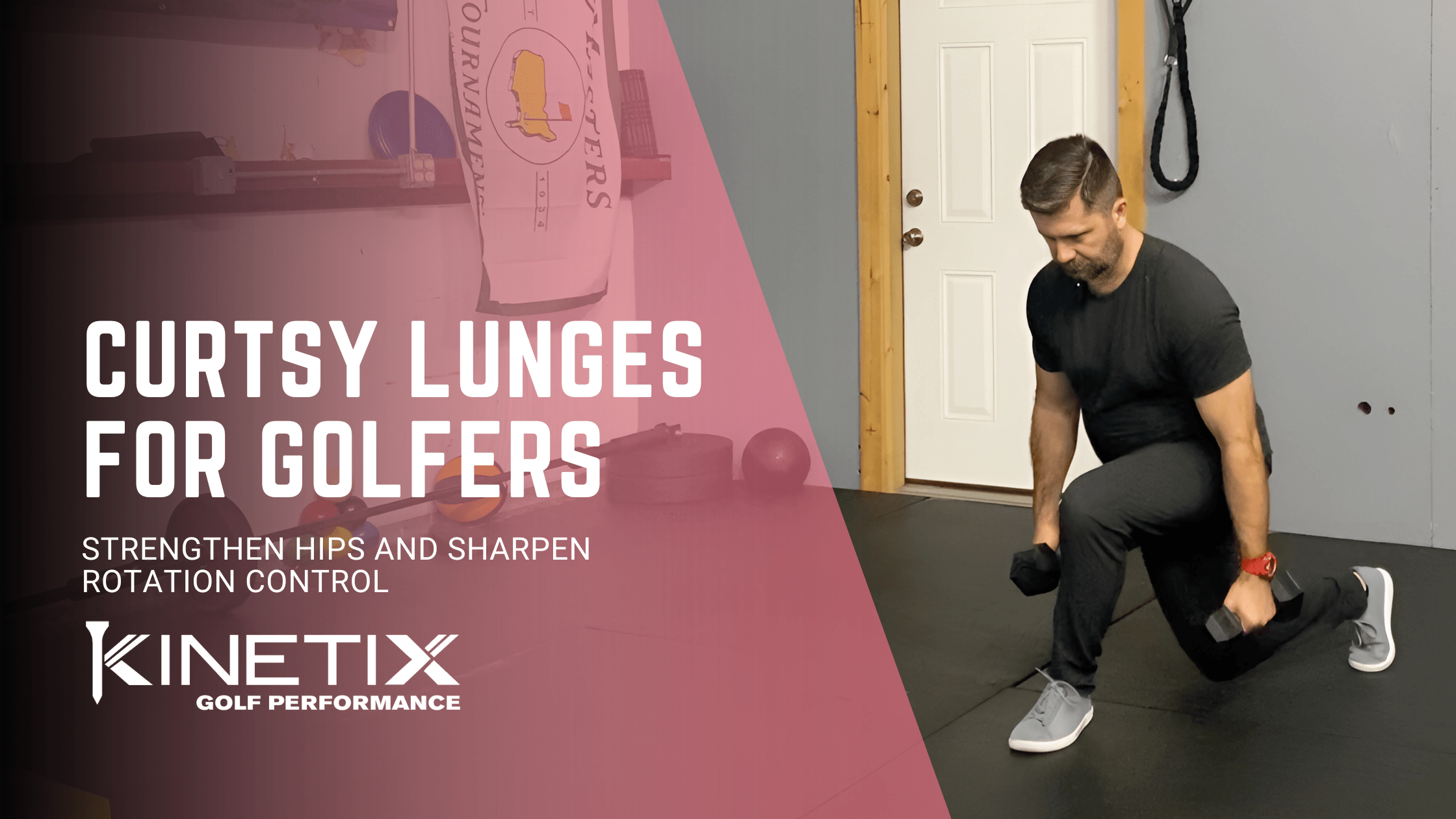
Golfer performing curtsy lunge exercise to improve hip mobility and lateral strength for better golf swing

If your golf swing lacks stability or you feel like your hips aren’t rotating fluidly through impact, the curtsy lunge might be the missing piece.

While often overlooked in traditional strength training programs, this lunge variation develops:

  • Hip internal rotation (IR)
  • Adductor strength and control
  • Single-leg stability and mobility

In short, it trains the exact physical characteristics that support a powerful, efficient, and pain-free golf swing.


What is a Curtsy Lunge?

The curtsy lunge is a variation of the reverse lunge that crosses the rear leg diagonally behind the front leg as you step back and lower. This creates a unique challenge to the lead hip, forcing it to stabilize while moving through:

  • Hip adduction
  • Hip internal rotation
  • Dynamic balance and alignment

Unlike traditional lunges, the curtsy targets muscles and movement planes that are often neglected—but are critical for rotational sports like golf.


Why Curtsy Lunges Belong in Golf Workouts

The curtsy lunge brings specific benefits to golfers who want to:

  • Improve lead leg posting during the downswing
  • Increase hip rotational capacity
  • Strengthen through end ranges (like IR)
  • Prevent excessive swaying or sliding in the lower body
  • Enhance pelvic control through transition

This movement builds the strength and control to rotate around a stable hip, instead of leaking energy forward or sideways.


How to Perform a Curtsy Lunge (Golf Version)

Equipment: Dumbbells, kettlebells, or a landmine bar setup

Step-by-Step:

  1. Stand tall with feet shoulder-width apart
  2. Step one leg diagonally behind the front leg
  3. Lower down slowly, maintaining a tall spine
  4. Feel the load in the lead glute and adductor
  5. Drive through the front foot to return to standing

✅ Keep knees tracking over toes
✅ Avoid collapsing at the torso
✅ Stay stable through the full range of motion


Variations and Progressions

1. Bodyweight Curtsy Lunge

Perfect for warm-ups, mobility drills, or senior golfers focusing on control and balance.

2. Weighted Curtsy Lunge

Use dumbbells or kettlebells to build strength. Hold weight in a goblet position for added core activation.

3. Landmine Curtsy Lunge

Our favorite—using a landmine barbell setup to guide motion and add progressive overload. The arc of the landmine naturally supports the rotational challenge.

4. Tempo Curtsy Lunge

Slow the descent (3–5 seconds down) to increase time under tension and build tendon resilience in the hips.


How It Translates to the Golf Swing

Golfers need hip stability and control, especially in the lead leg during the transition and downswing. The curtsy lunge reinforces:

  • The upright “posting” action on the lead leg
  • Rotational strength under load
  • Controlled internal rotation at the hip joint
  • Lateral and diagonal force absorption

It doesn’t just make your hips stronger—it makes your swing more stable, powerful, and repeatable.


Great for Senior Golfers, Too

Curtsy lunges can be scaled for golfers of all ages. Use a support (like a rack or foam roller) to help maintain balance. Limit depth to comfort level and avoid pain.

You’ll still gain:

  • Improved hip mobility
  • Better single-leg coordination
  • Enhanced functional balance

Programming Suggestions

Place the curtsy lunge in your B or C Block—after warm-ups but before high-speed or ballistic movements.

Sample Prescription:

  • 3–4 sets
  • 6–8 reps per leg
  • Add tempo (slow lower) or resistance as needed
  • Superset with hip mobility drills or anti-rotation core work

Curtsy Lunges = Golf Power + Control

While they may not look “golfy,” curtsy lunges are golf-specific where it matters most: in building the rotational strength, hip mobility, and lower-body control required for a powerful, injury-resistant swing.

It’s not about mimicking the swing—it’s about preparing your body to perform the swing better.


Ready to Move Better, Swing Faster, and Feel Stronger?

Start training with intention. Our online golf performance programs are designed for golfers at any level to build speed, stability, and longevity in their game.

This exercise is just one of the dozens of targeted golf exercises in our PinSeeker Performance Program—a 6-week, lifetime-access golf workout program designed to build mobility, strength, and power exactly where you need it.

🏌️‍♂️ Swing with more rotation and less pain
🏋️‍♀️ Improve strength, flexibility, and balance
⛳️ Play more consistently, regardless of age or experience

✅ One-time purchase
✅ Lifetime access
✅ Golf-Specific workouts you can do anywhere

Train smarter, swing stronger, and see real gains on the course with PinSeeker!

our 6-week pinseeker performance program is the best online golf fitness program

Posted on — Leave a comment

Copenhagen Planks for Golf: Unlock Hip Control and Adductor Strength

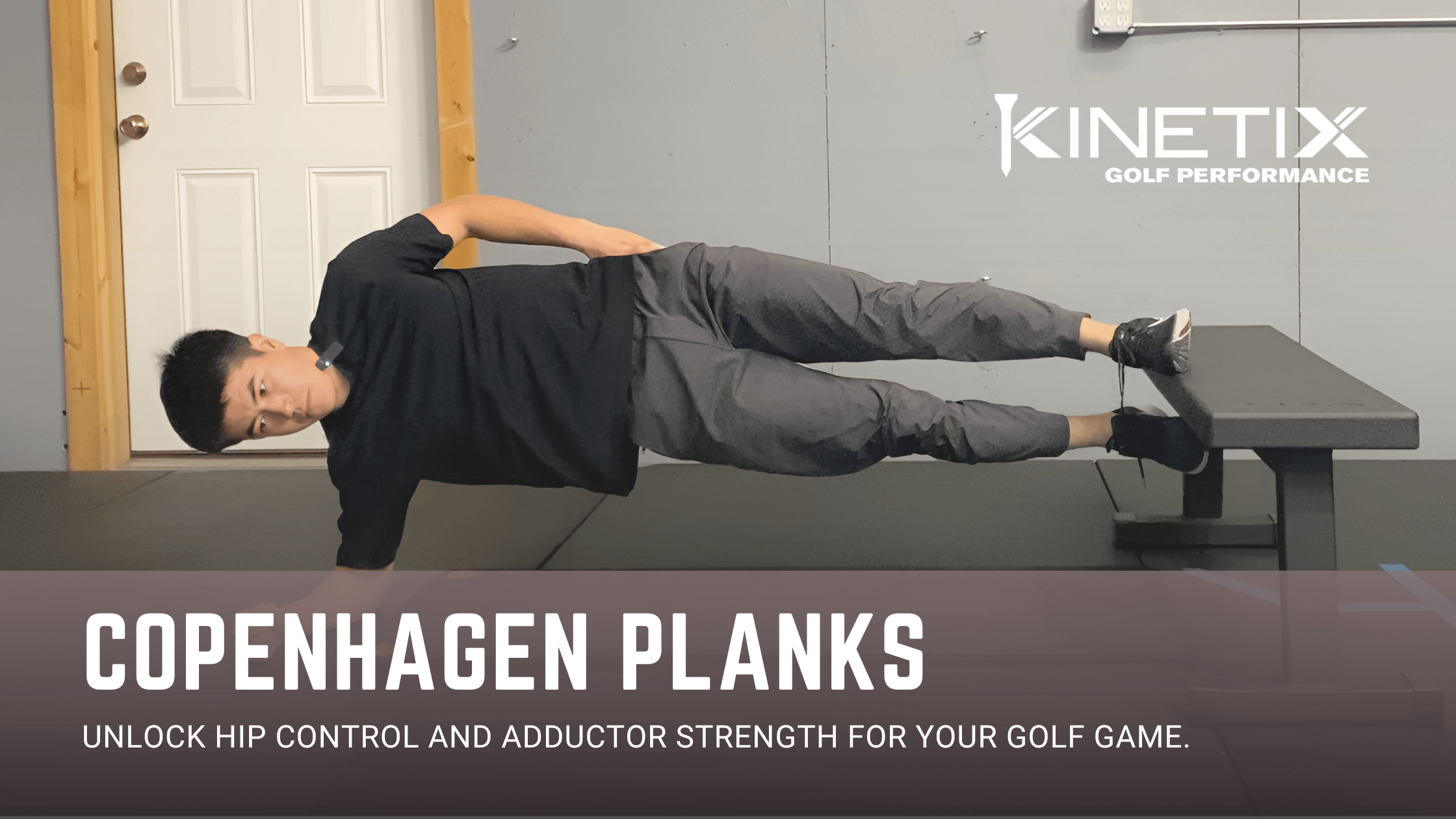
copenhagen planks are a great golf exercises to strengthen your adductor muscles group which is a key muscle group to develop stability in your downswing.

Not every “golf exercise” involves swinging a club or throwing a med ball. Some of the most effective tools in your golf fitness arsenal are foundational movements that build isometric strength and stabilize the hips—like the underrated yet powerful Copenhagen plank.

At Kinetix Golf Performance, we use Copenhagen planks in our A block movement prep on days focused on hip control, lateral chain strength, and core activation. While the move looks simple—an adductor side plank variation—it packs serious punch when it comes to controlling pelvic movement, especially during transition and follow-through in the golf swing.


Why Golfers Need Adductor Strength

The adductors (inner thigh muscles) are often overlooked in golf training—but they play a huge role in your swing mechanics:

  • Stabilizing the pelvis during rotation and weight transfer
  • Controlling movement in the frontal plane (side-to-side stability)
  • Supporting single-leg stance, especially when posting on the lead side
  • Balancing the glutes and abductors to prevent compensation patterns

When adductors are weak, your hips and pelvis become unstable during swing phases, often leading to:

  • Loss of posture
  • Swaying or sliding
  • Overactive QL or hamstrings
  • Low back or groin discomfort

That’s where Copenhagen planks come in—an isometric powerhouse for strengthening the adductors, building tissue resilience, and improving pelvic control under load.


How to Perform Copenhagen Planks: 3 Progression Levels

Start with the variation that suits your current strength level, then progressively increase the challenge by extending the lever arm.

✅ Level 1 – Knee on Bench

  • Place your top knee on a bench, bottom leg straight and off the ground
  • Forearm planted under shoulder (side plank position)
  • Lift hips and hold, engaging core and adductors

✅ Level 2 – Mid Shin on Bench

  • Move the top leg out so your mid-shin is on the bench
  • This increases the lever and load on the adductor
  • Hold for :15–:30 seconds

✅ Level 3 – Ankle/Foot on Bench

  • Full-length variation: top ankle or foot rests on the bench
  • Most demanding version, challenging hip control, core engagement, and adductor strength
  • Keep the bottom leg off the ground for max intensity

🔁 Sets/Reps Recommendation:


How Copenhagen Planks Fit Into Your Golf Training

While not flashy, Copenhagen planks are a stability essential. They help you:

  • Stay stacked and grounded during the swing
  • Maintain lower-body integrity during rotation
  • Develop strength that transfers to both swing power and injury prevention

Golfers often overlook the importance of frontal plane control—but it’s this very control that keeps you from sliding, overextending, or compensating when things get dynamic.

By adding Copenhagen planks into your warm-up/movement prep phase, you create a more stable and powerful foundation for swing-specific work later in your program.


Real Golf Performance Gains Start with the Basics

At Kinetix Golf Performance, we believe golf training isn’t about gimmicks—it’s about results.

And results come from combining foundational strength work like Copenhagen planks, wall sits, and hip CARs with dynamic rotational training like landmine presses, med ball throws, and bear holds with pull-throughs.

Ready to build a more balanced, powerful, and pain-free golf swing?

This exercise is just one of the dozens of targeted golf exercises in our PinSeeker Performance Program—a 6-week, lifetime-access golf workout program designed to build mobility, strength, and power exactly where you need it.

🏌️‍♂️ Swing with more rotation and less pain
🏋️‍♀️ Improve strength, flexibility, and balance
⛳️ Play more consistently, regardless of age or experience

✅ One-time purchase
✅ Lifetime access
✅ Golf-Specific workouts you can do anywhere

Train smarter, swing stronger, and see real gains on the course with PinSeeker!
our 6-week pinseeker performance program is the best online golf fitness program