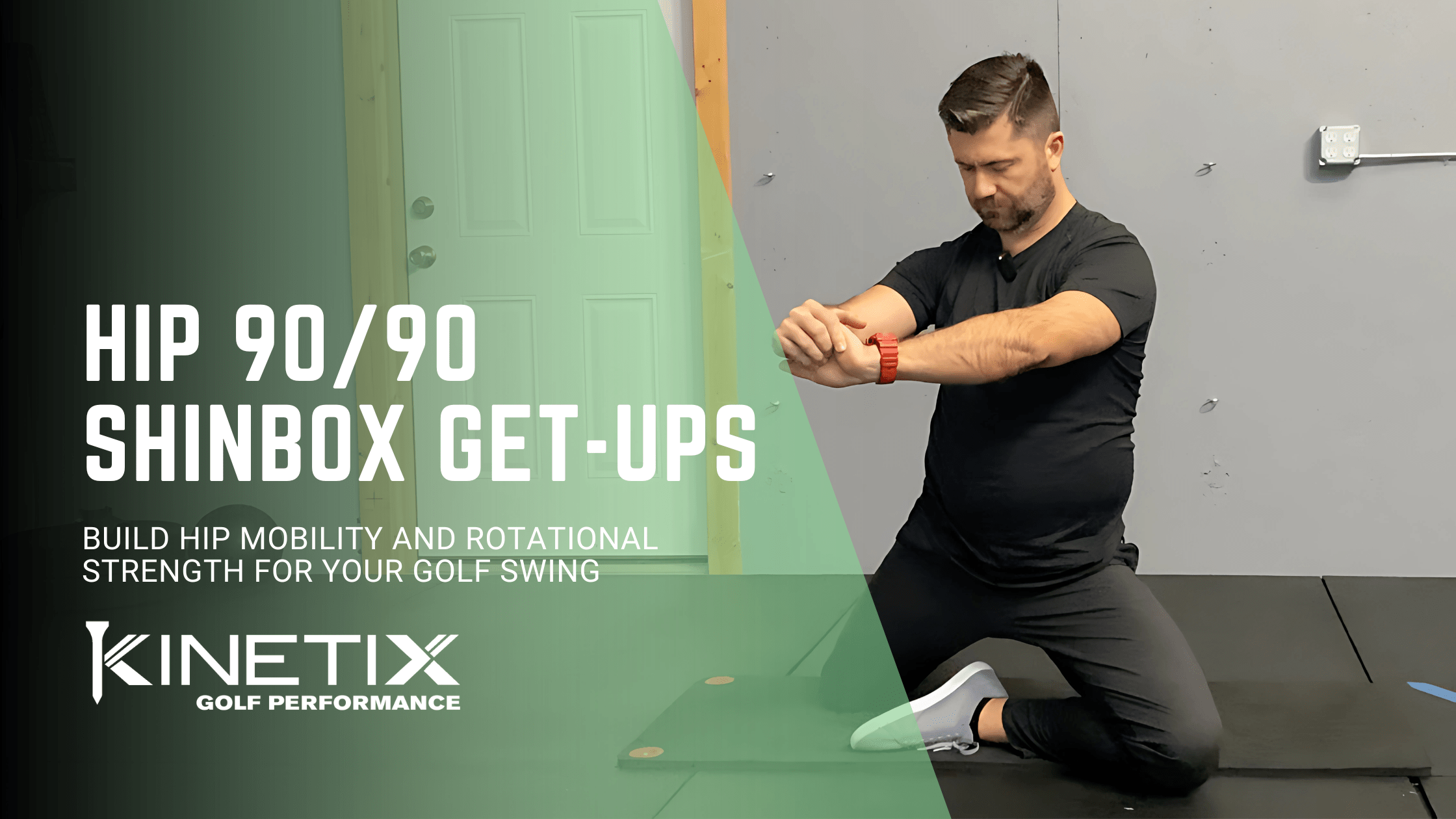
Golf is a rotational sport. But before you can unlock a smooth and powerful swing, you need functional hip mobility—specifically the ability to control internal and external rotation through your entire swing arc. One of our go-to exercises for training this? The 90/90 shinbox with get-ups.
This drill isn’t just for flexibility—it builds strength, control, and power at your end ranges, which is critical if you want to rotate efficiently and reduce compensation through your lower back or knees.
Whether you’re preparing for a round or warming up for a lower-body strength session, the shinbox get-up belongs in your A-block (movement prep phase).
Why Hip Rotation Is Crucial for Golf Performance
Your hips play a major role in:
- Initiating the backswing
- Transitioning through the downswing
- Transferring force through the kinetic chain
- Decelerating the swing without injury
Yet many golfers lack control in two key motions:
- Internal Rotation of the lead hip during the downswing
- External Rotation of the trail hip during the downswing
- Internal Rotation of the trail hip during the backswing
- External Rotation of the lead hip during the backswing
This lack of mobility and strength often shows up as:
- Early extension
- Swaying or sliding
- Lower back pain
- Loss of clubhead speed
What Is the 90/90 Shinbox Get-Up?
The 90/90 position places your front leg in external rotation and your back leg in internal rotation, mimicking the hip shapes seen during a golf swing. When you add the get-up, you begin training strength and motor control through those ranges.
How to Perform It:
- Sit on the floor in a 90/90 position:
- Front leg bent in front of you at 90 degrees
- Back leg bent behind you at 90 degrees
- Maintain a tall spine as you lean forward slightly into the front hip (active stretch)
- From this position, drive through the front leg to lift your hips off the floor and come to a kneeling or tall kneeling position
- Reverse the motion with control to return to seated 90/90
- Switch sides and repeat
Coaching Tips:
- Keep your torso tall throughout the movement
- Use your glutes and adductors to initiate the lift—not momentum
- If needed, use a support (club, dowel, or foam roller) to assist balance
Why Golfers Should Train Hip Rotation in End Ranges
Most golfers only rotate their hips dynamically—but rarely train strength or control in the actual end ranges of motion. This exercise changes that.
✅ External Rotation helps load the backswing on the lead side
✅ Internal Rotation supports the downswing transition and helps decelerate rotation on the lead side
By getting stronger in these positions, you:
- Create more efficient hip turn in your swing
- Reduce pressure on the lower back and knees
- Improve sequencing between hips and torso
- Build better balance and coordination between both sides of your body
Who Should Use 90/90 Get-Ups?
This exercise is suitable for:
- ✅ Younger athletes seeking more rotational speed
- ✅ Senior golfers looking to improve mobility safely
- ✅ Golfers rehabbing hip, groin, or lower back issues
- ✅ Anyone wanting to prep the body for lower-body lifts (deadlifts, lunges, etc.)
When to Program This Golf Exercise
We recommend incorporating 90/90 shinbox get-ups in your A Block—our term for movement preparation prior to a heavier lifting session or golf-specific speed/power work.
This gets your hips moving properly before placing load or asking for high-velocity rotation.
Suggested prescription:
- 2–3 sets of 3–5 reps per side
- Perform at the beginning of your golf workout, 2–3 times per week
Golf-Specific? You Bet.
While this exercise may not look like a swing drill, it directly targets the mobility and control patterns that transfer to a better, safer, and more powerful swing.
Remember:
Golf-specific doesn’t just mean mimicking your swing.
It means training the systems that support your swing—hip control, joint stability, sequencing, and movement efficiency.
Build Better Hips, Build a Better Swing
If you’re struggling with:
- A slide during the downswing
- Limited hip turn
- Lower back discomfort
- Or simply want to unlock more rotation in your swing…
…then the 90/90 shinbox get-up needs to be in your weekly routine.
This simple but powerful move will make a big difference in how you move and perform on the course.
This exercise is just one of the dozens of targeted golf exercises in our PinSeeker Performance Program—a 6-week, lifetime-access golf workout program designed to build mobility, strength, and power exactly where you need it.
🏌️♂️ Swing with more rotation and less pain
🏋️♀️ Improve strength, flexibility, and balance
⛳️ Play more consistently, regardless of age or experience
✅ One-time purchase
✅ Lifetime access
✅ Golf-Specific workouts you can do anywhere
Train smarter, swing stronger, and see real gains on the course with PinSeeker!