Posted on — Leave a comment

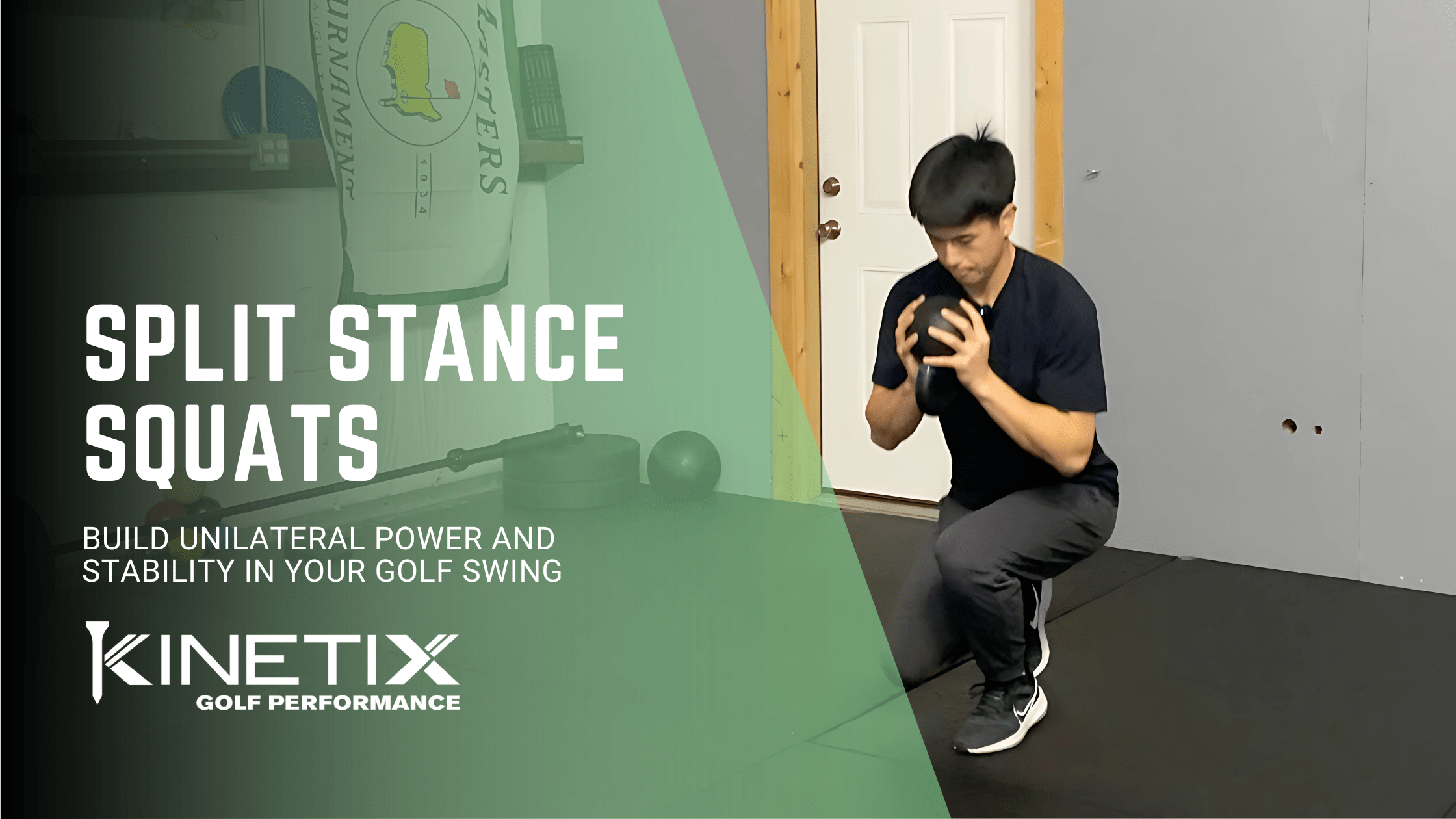
Split Squats for Golfers: Build Unilateral Power and Stability in Your Golf Swing

The split stance squat is a great golf exercises for building unilateral leg power and stability in your golf swing.

When it comes to building rotational power and balance in your golf swing, few exercises offer the functional benefits of split squats. This unilateral lower body exercise helps golfers train each leg independently, which is crucial since the golf swing isn’t symmetrical. The transfer of weight, rotation through the hips, and drive off the lead leg all demand strong and stable legs.

Split squats are a cornerstone in our golf performance programs—whether you’re an amateur or chasing scratch, this movement helps you create better ground reaction force, hip stability, and swing consistency.


Why Split Squats Matter for Golfers

Here’s how split squats translate directly to the golf course:

  • Unilateral Strength & Motor Recruitment: Training one leg at a time improves strength asymmetries and requires more neural drive, meaning more motor units are firing—critical for building power in the downswing.
  • Improved Weight Transfer: The golf swing requires proper load into the trail leg and a powerful shift into the lead leg. Split squats reinforce this pattern under control.
  • Better Hip Mobility & Stability: Working through a full range of motion builds strength in end ranges of hip flexion and extension, important for both backswing depth and follow-through rotation.
  • Scalable for All Fitness Levels: You can start with a kickstand (toe-down) back leg for support or progress to a rear-foot elevated split squat (RFESS) for greater range and challenge.

How to Perform a Split Squat for Golf

  1. Kickstand Split Squat
    • Start with your back foot resting lightly behind you (toe down).
    • Front foot planted, hip-width apart.
    • Lower down with control, keeping the torso upright.
    • Drive through the front heel to return to standing.
  2. Rear Foot Elevated Split Squat
    • Elevate the rear foot on a bench or low box.
    • Lower until your front thigh is parallel to the ground.
    • Keep tension in the quads, glutes, and hamstrings of the lead leg.
    • Keep your pelvis neutral—no arching or collapsing forward.

Programming Tips

We typically program split squats in the main strength block of our workouts:

  • Reps: 6 per leg
  • Sets: 3–4
  • Tempo: Slow eccentric (3 seconds down), fast concentric (explode up)
  • Optional Superset: Contrast with split stance med ball tosses for rotational power.

Split Squats and Golf Swing Translation

In your golf swing, a strong and stable lead leg is your post—it’s what you rotate around and push against to generate clubhead speed. Without stability in that post leg, you may leak power or lose consistency due to sway or slide. Split squats teach your body to control that movement and produce force exactly where it’s needed.


Final Thoughts

Split squats aren’t just a leg day staple—they’re a golf performance essential. Whether you’re in-season or building during the off-season, these should have a permanent place in your golf strength program.

Want golf workouts that build power and mobility without wasting time?

This exercise is just one of the dozens of targeted golf exercises in our PinSeeker Performance Program—a 6-week, lifetime-access golf workout program designed to build mobility, strength, and power exactly where you need it.

🏌️‍♂️ Swing with more rotation and less pain
🏋️‍♀️ Improve strength, flexibility, and balance
⛳️ Play more consistently, regardless of age or experience

✅ One-time purchase
✅ Lifetime access
✅ Golf-Specific workouts you can do anywhere

Train smarter, swing stronger, and see real gains on the course with PinSeeker!

our 6-week pinseeker performance program is the best online golf fitness program

Posted on — Leave a comment

Banded Rotation Pull Backs: Build Rotational Power & Pulling Strength for Your Golf Swing

If you’re looking for a simple but powerful way to generate more speed, improve hip rotation, and maximize pulling strength in your golf swing, the banded rotation pull back should be in your training arsenal.

This highly targeted golf exercise is designed to replicate and train the rotational mechanics of the swing by leveraging resistance in the pulling phase—all while maintaining your golf-specific posture.


What Is the Banded Rotation Pull Back?

The banded rotation pull back is a resistance-based drill where the golfer assumes a golf posture, then performs a rotational pull using a resistance band anchored in front of them. The movement simulates the transition phase of the golf swing, where the hips initiate rotation, and the upper body follows with a powerful pull.

Unlike many gym-based rotational exercises, this drill keeps the golf stance intact, making it highly transferable to on-course performance.


Why This Golf Exercise Matters

✅ Trains Hip-Led Rotation
Initiating the pull from the hips ensures the correct kinematic sequence, where the lower body leads and the upper body follows—a must for an efficient and powerful swing.

✅ Builds Pulling Strength
By resisting the band through rotation, you activate key pulling muscles: latissimus dorsi, rhomboids, mid-back stabilizers, and the obliques—all critical for club control and acceleration.

✅ Improves Golf-Specific Mobility & Posture Control
Holding golf posture throughout the movement challenges your thoracic spine, lumbo-pelvic control, and rotational range of motion, all while maintaining posture stability.

✅ Boosts Swing Speed & Clubhead Velocity
Stronger, more coordinated pulling through rotation directly improves your ability to generate force, increase clubhead speed, and maintain swing consistency under load.


How to Perform Banded Rotation Pull Backs (Step-by-Step)

  1. Anchor a resistance band at chest height or slightly lower.
  2. Step back into a solid golf posture (hips hinged, knees slightly bent, spine neutral).
  3. Extend both arms out in front to grip the band.
  4. Initiate the movement by rotating your hips, then pull the band across your body (toward your trail side).
  5. Control the return to start, resisting the band’s pull.

Repeat for 8–12 reps per side.


Biomechanics Breakdown: Why It Works

  • Hip-led rotation builds kinetic chain sequencing for smoother transitions.
  • Pulling through resistance replicates the downswing acceleration phase.
  • Thoracic rotation under tension improves mobility and rotational control.
  • Anti-rotation on the return phase trains control and deceleration, reducing risk of injury.

This drill also activates the deep core stabilizers, which are essential for maintaining posture and stability through the full swing.


Avoid These Common Mistakes

  • ❌ Rotating from the shoulders only (instead of leading with hips)
  • ❌ Standing upright instead of maintaining golf posture
  • ❌ Letting the band control the return instead of resisting it

Who Should Use This Exercise?

  • Golfers struggling with swing speed
  • Players lacking hip rotation
  • Athletes wanting better kinematic sequencing
  • Anyone training golf-specific pulling mechanics

Add to Your Program for Maximum Gains

  • Use this exercise as a power warm-up before strength sessions.
  • Pair it with med ball rotational throws, kickstand balance turns, or landmine jerk presses for a complete rotation/power block.
  • Aim for 2–3 sets per side, 2–3x/week.

Want More? Dive Deeper Into These Related Posts:


Trust Kinetix Golf Performance: Your Golf Fitness Authority

At Kinetix Golf Performance, we don’t throw random exercises at golfers. Every drill is biomechanically grounded, tested in real golf athletes, and programmed for real results.

This exercise is just one of the dozens of targeted golf exercises in our PinSeeker Performance Program—a 6-week, lifetime-access golf workout program designed to build mobility, strength, and power exactly where you need it.

🏌️‍♂️ Swing with more rotation and less pain
🏋️‍♀️ Improve strength, flexibility, and balance
⛳️ Play more consistently, regardless of age or experience

✅ One-time purchase
✅ Lifetime access
✅ Golf-Specific workouts you can do anywhere

Train smarter, swing stronger, and see real gains on the course with PinSeeker!
our 6-week pinseeker performance program is the best online golf fitness program

Posted on — Leave a comment

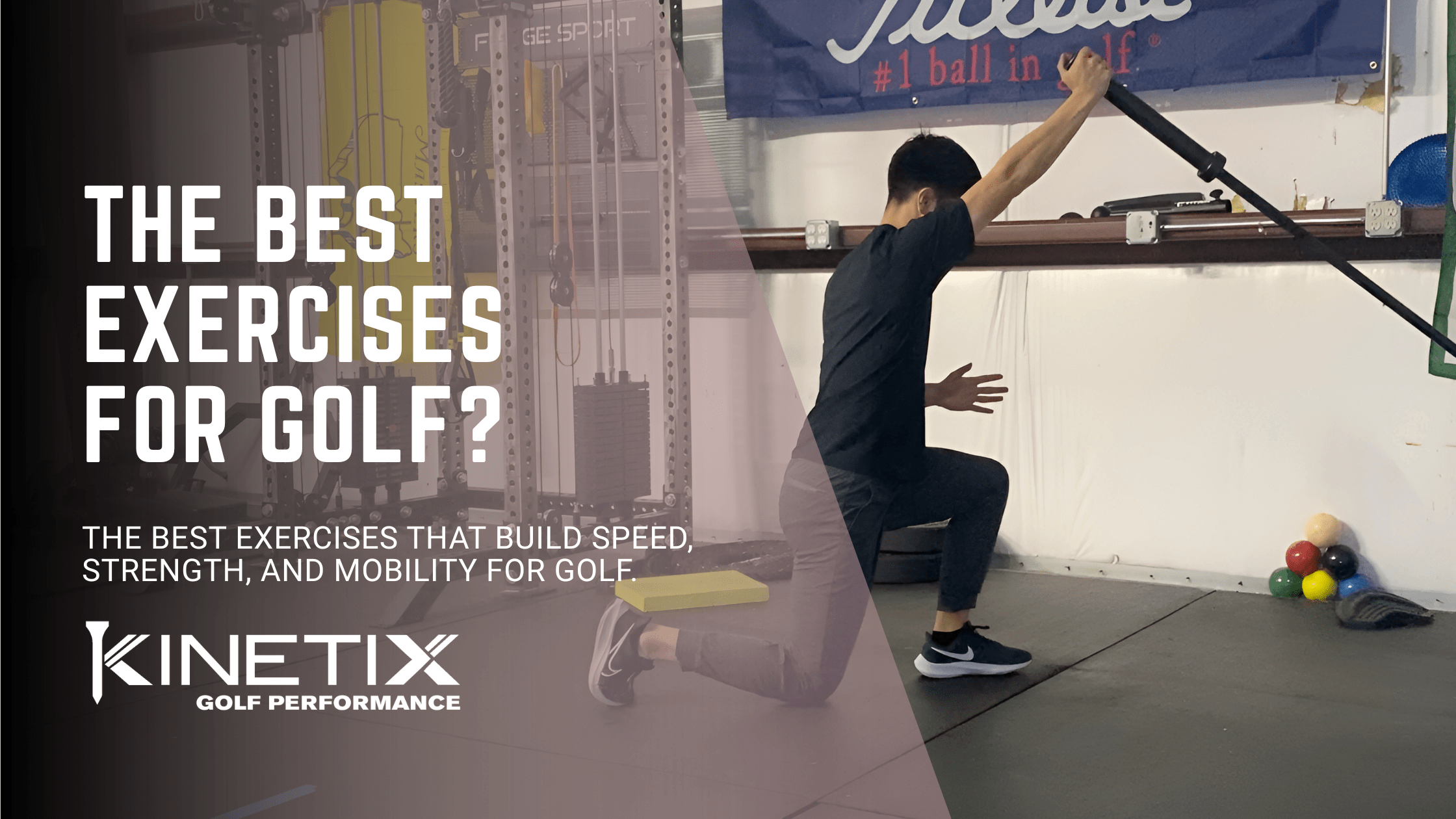
What Are the Best Exercises for Golf?

We help answer the question, what are the best exercises for golf.

The 5 Training Buckets That Should Be in Every Golfer’s Program

If you’ve searched “what are the best exercises for golf”, you’re not alone—and you’re asking the right question.

But here’s the truth: There is no one-size-fits-all list of “best exercises.” Instead, the best approach is to train within five key movement categories, or buckets, that mirror the physical demands of golf. These buckets allow us to progress or regress movements based on fitness level, age, mobility, or training goals.

Whether you’re a weekend golfer looking to avoid injury, or a competitive player trying to add 10+ yards to your drive, these five categories form the foundation of any smart golf fitness program.


1. Jumping: Build Explosiveness from the Ground Up

Why it matters:
The golf swing starts from the ground. The better you are at producing and controlling force through the lower body, the more clubhead speed and ball distance you can generate.

Jumping exercises train your fast-twitch muscle fibers, build explosive power, and improve how you absorb force (which helps prevent injury).

Sample Jumping Exercises for Golf:

  • Broad jumps
  • Depth jumps + stick landings
  • Split stance jumps
  • Med ball overhead throws

Jumping focused exercises also teaches deceleration—a critical skill during the downswing when force must be redirected through your lead leg.


2. Hip Hinges and Squats: Strengthen Your Base

Why it matters:
Your hips are the engine of your swing. Without strong glutes, hamstrings, and quads, your swing won’t have the power—or stability—you need to repeat it consistently.

Hinge and squat patterns build the posterior chain and increase lower body strength. This also complements your jump work and helps transfer force into your upper body.

Best Exercises in This Bucket:

  • Trap bar deadlifts
  • Rear foot elevated split squats
  • Kettlebell goblet squats
  • Romanian deadlifts
  • Iso lunges (holds for resilience)

These aren’t flashy, “golf-y” exercises—but they work. And they scale easily across fitness levels.


3. Anti-Rotation: Train Stability to Unlock Speed

Why it matters:
Speed without control is a recipe for swing faults and back pain. That’s why anti-rotation exercises are essential for golfers.

They build core stability, improve low back control, and help maintain posture throughout the swing.

And here’s the kicker—when the core is trained to resist rotation, it actually improves your ability to rotate efficiently through the thoracic spine and hips.

Key Anti-Rotation Golf Exercises:

  • Pallof press (standing or half kneeling)
  • Dead bug variations
  • Bird dog holds or reach + pull
  • Cable anti-rotation holds with stepping
  • High Bear pull-throughs

Think of this bucket as the glue holding everything together—protecting your spine while increasing rotational efficiency.


4. Push/Pull Patterns: Build Balanced Strength

Why it matters:
Golfers need strong shoulders, lats, legs and upper backs—but it’s not about being jacked. It’s about building unilateral strength, control, and balance across your pushing and pulling systems.

You need horizontal and vertical pulls, and yes, pushes too. This bucket should also include a rotational push/pull component that will compliment our mobility bucket.

Smart Push/Pull Movements for Golf:

  • Seated or half kneeling single-arm lat pulldowns
  • Face pulls (for shoulder external rotation)
  • Horizontal rows with mid-back rotation
  • Unilateral dumbbell presses (with opposing pulls)
  • Landmine presses + cable pulls

This bucket builds the neuromuscular coordination of your swing, especially when you match push and pull patterns across the midline.


5. Mobility: Own Your Range of Motion

Why it matters:
Mobility is more than flexibility. It’s the ability to control strength through full ranges of motion—especially in the joints critical to the golf swing.

The most important mobility areas for golfers:

  • Thoracic spine (mid back)
  • Hips (internal + external rotation)
  • Ankles (for ground contact + balance)
  • Shoulders (for swing plane and overhead control)
  • Neck + wrist (for fluid rotation + release)

Without mobility, your swing gets out of sequence. You compensate, lose posture, or overload other areas like the low back.

Best Mobility Exercises for Golfers:

  • 90/90 get-ups
  • Adductor rock backs
  • Thoracic mobility drills
  • Deep lunge with rotation

Mobility is a daily practice. It should be woven into your warmups, cooldowns, and recovery days.


How We Program This at Kinetix Golf Performance

Every golfer we work with—online or in person—gets a plan built on these five movement categories.

That’s how we built our 6-week golf performance program:

  • Mobility and activation in the A block
  • Strength and power in the B/C blocks
  • Finishers, contrast training, and recovery baked in
  • Adjusted for fitness level and equipment access

We don’t chase trends. We build repeatable athleticism for real-world golf performance.


Final Thoughts: The Best Golf Exercises Come from Smart Buckets

If you came here looking for a magic list of “Top 5 Golf Exercises”—you now know the real answer.

It’s not about finding one perfect exercise. It’s about training within the right buckets, in the right order, with the right level of progression for your body and goals.

Train smarter. Build capacity. Hit better shots.


Ready to Train Like a Golfer?

This exercise is just one of the dozens of targeted golf exercises in our PinSeeker Performance Program—a 6-week, lifetime-access golf workout program designed to build mobility, strength, and power exactly where you need it.

🏌️‍♂️ Swing with more rotation and less pain
🏋️‍♀️ Improve strength, flexibility, and balance
⛳️ Play more consistently, regardless of age or experience

✅ One-time purchase
✅ Lifetime access
✅ Golf-Specific workouts you can do anywhere

Train smarter, swing stronger, and see real gains on the course with PinSeeker!

our 6-week pinseeker performance program is the best online golf fitness program